Republican U.S. Rep. Thomas Massie is the lone holdout in the state’s Washington delegation, refusing to make six-figure contributions to congressional committees from their own campaign funds and PACs — a system both parties impose.
Massie, who represents the fourth congressional district from Lewis County, likened the dues system to “extortion,” because he said those who give win an edge in better committee assignments, according to a USA Today report this morning. He’s given only $6,000 of an expected $240,000.
Other delegation members denied they were giving under duress. How much the Republican members donated during the 2013-14 campaign cycle to the Republican Congressional Committee, according to The Courier-Journal:
The delegation’s lone Democrat, John Yarmuth of Louisville in the third district, gave $265,000 during the 2014 cycle to the Democratic Congressional Campaign Committee.
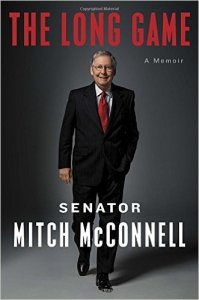
In “The Long Game,” Republican U.S. senate majority leader Mitch McConnell slams the man he calls “Professor Obama” and needles fellow lawmakers, ABC News says in a new story. It hits bookstores next Tuesday.
McConnell told the Associated Press a year ago that he was writing the book. But he didn’t say how much he’d get paid. Now, his new financial disclosure report filed last week shows what publisher Penguin forked over: $325,000 — and that’s just to start. He’ll also receive royalty payments: 15% of sales at the retail price of hardcover editions; 7.5% to 10% of sales of paperbacks; and 25% of e-book sales.
This is McConnell’s biggest foray into book publishing. If sales go through the roof, he could earn a bigger advance next time. But as political books go, it’s a long road to match what Simon & Schuster paid Hillary Clinton in 2000 for her memoirs as first lady: a near-record $8 million. (And that’s not counting the rumored $14 million for her years as secretary of state.) In fact, McConnell’s pales alongside a list Boulevard compiled of other high-profile authors going back to 2001.
The 20-page disclosure report covering all of 2015 is full of details about McConnell’s finances and those of his wife, the economist Elaine Chao. Among them, Chao got paid five figures for speeches she gave to the Alliance for Public Awareness in Paris ($50,000), and the Real Estate Roundtable in Washington ($25,000). Chao was U.S. labor secretary in the George W. Bush Administration.
With Chao’s substantial family wealth included, McConnell ranked No. 11 among the senate’s wealthiest members as of 2014, the latest year available from the Center for Responsive Politics, a nonpartisan campaign finance watchdog group.
Business First has a curious story about political campaign contributions in its current issue both in print and on its website. (We won’t link to the web version because it’s only for subscribers). The story lists the Louisville area’s top 30 individual donors for the 2016 election cycle — this includes White House candidates — and says whether their gifts went mostly to Democrats or to Republicans. The names were compiled for the business weekly by the well-regarded Center for Responsive Politics, a non-partisan group in Washington that tracks campaign finance.
Here’s what’s odd; bear with us, because it’s complicated. The story says the No. 1 donor is a retired Dr. Mark Jones, who’s said to have given a total $200,950 primarily to Republicans. He’s far and away the most generous donor listed; No. 2 is the philanthropist Christy Brown, who’s given $76,600 (mostly to Democrats), according to the list.
But Boulevard wonders whether the center has erred. We used its searchable database to build our own list of the biggest Kentucky donors for the 2016 election cycle. At the top of our list: one David A. Jones, identified only as a Louisville retiree who gave $200,000 on Sept. 14 to the Kentuckians for Strong Leadership PAC.
Jones
He’s almost certainly Humana co-founder David A. Jones Sr.; the PAC lists his $200,000 gift, and his West Main Street office address in its annual 2015 Federal Election Commission report. (Moreover, if you search solely for any David A. Joneses, you turn up another five donations totaling $41,500 from a retired David A. Jones Sr., including $33,400 on May 27, 2015, to the Republican National Committee. However, it doesn’t look like these gifts were from his son, venture capitalist and Humana director David A. Jones Jr.; these appear to be from Jones Sr.)
Back to the Business First story. The center’s database does, indeed, show two contributions by a Dr. Mark Robert Jones of Louisville, but totaling only $950. And unlike Business First’s account, Jones isn’t identified as retired. The donations went to 21st Century Oncology; it’s unclear whether that’s a PAC.
Did the center mistakenly credit the $200,000 from David Jones Sr. to Dr. Jones and his $950, pushing the doctor to the top of the list? It certainly seems possible. That would mean the Humana co-founder is the real top donor, with a total $241,500. We’ll watch Business First for any clarification in the days ahead.
McConnell
This much is certain: The Kentuckians for Strong Leadership PAC is solidly Republican. “Our highest priority in 2014,” its website says, “was ensuring the reelection of U.S. Senate Majority Leader Mitch McConnell. In 2016, we turn our attention to delivering control of Kentucky’s State House of Representatives to the Republican Party.”
Cherokee Park visitors at Hogan’s Fountain in 1920.
Frederick Law Olmsted died 113 years ago this August, so we can only imagine what he’d think of the emerald necklace of parks and parkways his famous New York firm designed for Louisville. Olmsted visited the city in 1891 at the invitation of prominent citizens with newly acquired land reserved for parks; he was 69 years old, and well into a second career (first one: newspaper reporter).
Louisville was flexing its big-city muscles at a time of huge population growth. The Southern Exposition of 1883-87 in what is now Old Louisville had shined a spotlight on the city — an electric one, in fact. One of the exposition’s top draws was the largest to-date installation of Thomas Edison’s incandescent light bulbs, to illuminate the exposition at night. (Edison had lived in Louisville 16 years before.) By Olmsted’s arrival, the city had 161,129 residents, a 60% increase in just the two decades after the Civil War.
The parks project ultimately grew to 18 parks and six parkways, public green space that links Louisville to one of Olmsted’s most famous works: Central Park in New York. (And, indeed, we have our own Olmsted-designed Central Park, in Old Louisville.) Much of the work was certainly executed by Olmsted’s firm, rather than the man himself. Tragically, just four years after he visited Louisville, senility forced Olmsted to retire. He died in 1903 at McLean Hospital in suburban Boston, originally an asylum for the insane.
This morning, we heard Olmsted’s history retold when several hundred people crowded into an auditorium on the Bellarmine campus for the Olmsted Park Conservancy‘s annual fundraising breakfast. Mimi Zinniel, the group’s CEO, runs a tight ship: The event’s notice promised Heine Bros. coffee and a chance to network from 7:30 until 8, when the program would start promptly, concluding by 9. This made sense, because most of the attendees would soon be on their way to work. Nearing 8, the din of so many people talking at once was amplified by the cavernous space, which looked like a basketball court, minus hoops, but with dozens of linen-topped round tables. On the menu: yogurt parfait with granola and fresh blueberries, and quiche Lorraine.
The speakers’ remarks were mercifully short and to the point, with videos adding entertaining pizzazz; one featured children and parents proclaiming which parks were their favorite. But the video drawing the most cheers came midway through. It starred retiring Metro Council member Tom Owen, whose district includes one of the biggest and best-known: Cherokee Park in the Highlands. Owen’s just-elected successor, Brandon Coan, wore a cream-colored suit and greeted well-wishers. Boulevard complimented him on his campaign’s financial efficiency — spending just $18 per vote vs. the $63 spent by the No. 2 finisher, Stephen Riley. Coan protested, but only mildly: “Actually, I think it was closer to $13.”
Olmsted
Squint your eyes a bit — well, a lot — and Owen bears a passing resemblance to Olmsted. Some of that’s the white beard, and age: Owen is now 76. Like Olmsted, he’s all about the outdoors, famously getting about the city on bicycle in a fluorescent-green safety vest. And that’s how he appeared in the video: touring the Olmsted parks as he told their history (history-telling being his other job, after all). Concluding his tour, Owen didn’t miss a chance to plug one of the fundraiser’s main sponsors.
“Now,” he said, “I’m going to pedal off and get a special cup of Heine Bros. coffee.” Cue applause.
Republican U.S. senators Mitch McConnell — already one of the chamber’s wealthiest members — and Rand Paul have now filed their mandatory annual financial disclosure reports.
The documents reveal sources of annual income, plus stock and other investments. Both men filed their reports Monday.
Lexington Mayor Jim Gray won the Democrats’ nomination for U.S. Senate yesterday by campaigning on his experience helping save the family’s Gray Inc. construction company after his father’s death. He’ll now face Republican Sen. Rand Paul in November — a contest he concedes will be tough.
Gray
“I have no illusions about it being a challenging race,” he told the Lexington Herald-Leader, “but I’ve got the experience and I’ve got the record. That experience is in the private sector, in building a family business.”
In the race to the senate, Gray, 62, joins other well-heeled candidates who’ve run on business bona fides, including Gov. Matt Bevin and White House hopeful Donald Trump. Gray’s first financial disclosure report, filed last month, offers a glimpse at that record.
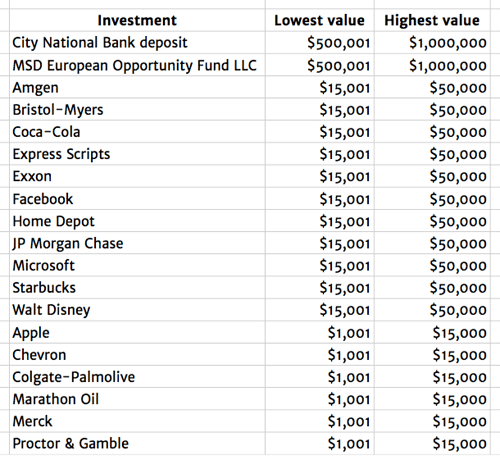
The April 15 report covers the period extending back to the start of 2015. As with all such reports candidates and office holders must file annually, Gray’s assigns only a range of values for his family’s business, real estate and stock holdings. An individual stock, for example, may be valued at between $15,001 and $50,000 — the value Gray gave to his investment in the biotech giant Amgen. What’s more, it’s a point-in-time view; there’s no way to know the value of any of the assets today, nor whether they’re even still owned.
Still, Gray’s report offers a revealing snapshot of his family’s more big-ticket assets:
Gray Inc.: valued between $5 million and $25 million
Gray Realty commercial property: $1 million to $5 million
Woodford Realty commercial property: $250,000 to $500,000
Visual and Antiquity Investments, which consists of contemporary paintings, sculptures, mixed media and rare books: $1 million to $5 million. The report doesn’t say whether this is a private collection or commercial venture
The report also lists stocks and other investment securities, with a combined value between $1.8 million and $4.1 million. The portfolio includes a mix of technology stocks (Apple and Facebook); pharmaceuticals (Bristol-Myers and Merck, in addition to Amgen) and consumer goods (Starbucks and Walt Disney). A partial list:
Finally, Gray also reported annual wages of $160,000 as mayor, and $125,000 from Gray Inc., where he’s non-executive board chairman.
 McConnell
  Business First has a curious story about political campaign contributions in its current issue both in print and on



 Boulevard