The Courier-Journal’s first reference to Ali by his chosen name didn’t come until 1969, five years after he adopted it.
Shortly after he defeated Sonny Liston to win the heavyweight title in February 1964, Cassius Clay changed his name to Muhammad Ali. The new name, bestowed by Nation of Islam leader Elijah Muhammad, “was important to Ali, who referred to Cassius Clay as his slave name and took umbrage when people used it,” The New York Times says in a new story.
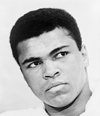
Ali in 1967.
But in The Courier-Journal, the Times, and many other papers and magazines, “Cassius Clay won the Liston rematch in 1965, Cassius Clay beat Cleveland Williams in 1966, and Cassius Clay refused to be inducted into the Army in 1967.”
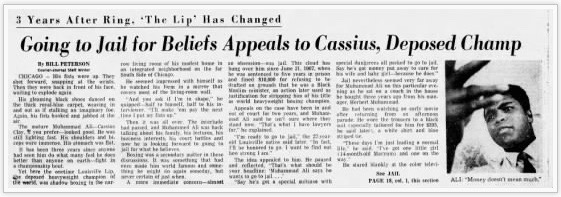
Indeed, the earliest CJ reference to the late Louisville native by his chosen name didn’t come until Aug 24, 1969, when the paper’s Bill Petersen interviewed him in Chicago, according to a search this morning of the CJ archives in Newspapers.com. At the time, Ali faced five years in prison and a $10,000* fine after his 1967 draft evasion conviction; on appeal, the U.S. Supreme Court eventually threw it out. (Correction: In fact, the CJ used “Ali” as early as 1964, the year he adopted it; please read this new post.)
Under a Page One headline that said, “Going to Jail for Beliefs Appeals to Cassius, Deposed Champ,” Peterson wrote: “The mature Muhammad Ali — Cassius Clay, if you prefer — looked good. He was still [lightning] fast. His shoulders and biceps were immense. His stomach was flat.”
Ali died last week in Phoenix, his primary home, after battling Parkinson’s disease for decades; he was 74. He will be buried at Cave Hill Cemetery today.
* $65,000 in 2016 dollars, according to the Bureau of Labor Statistics inflation calculator.
— an unidentified woman, after hearing attorney Bill Bardenwerper tell a community meeting that it actually took Papa John’s CEO John Schnattera full 15 minutes — rather than only 10 — to drive to company headquarters from his mansion in exclusive Anchorage. Schnatter met with neighbors last night to promise he’d limit his nearby helicoptering to cut down on any noise it created, according to Insider Louisville.
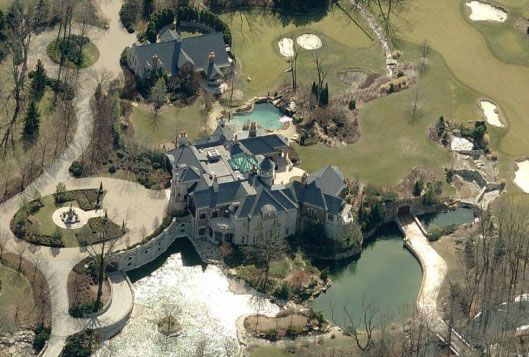
Schnatter’s palatial 40,000-square-foot home sits on 16 acres, and features a 22-car underground garage:
(If there’s a chopper pad there, we don’t see it.)
A news summary, focused on big employers; updated 4:51 p.m.
BROWN-FORMAN: Amid recent speculation the company is considering selling Finlandia, CEO Paul Varga threw tepid support behind the vodka brand during the fiscal fourth-quarter conference call with Wall Street analysts yesterday; he was responding to an analyst’s question about Finlandia’s being a “drag” on growth.
“Finlandia has been very important to particularly Jack Daniel’s development in Eastern Europe over the last decade,” Varga said, according to Seeking Alpha’s transcript. “It’s just a very difficult time for the vodka segments in those Eastern European countries right now, and we’ve seen this before with categories where they go through some rough times. . . . Right now, we continue to work Finlandia” (Seeking Alpha).
Creed
PIZZA HUT: Yum CEO Greg Creed, conceding in especially frank language that Domino’s has greater U.S. revenue momentum, says improving ordering technology is critical. “We have to get our technology in shape in order to be as easy to order, pay, and track [as possible],” he told an investor conference Wednesday, “and I think as we build the brand and we get that in shape, we’ll actually build more units and that will give us greater physical access.” Pizza Hut has 8,100 U.S. locations, including its Express format vs. more than 5,200 for Domino’s (The Street).
Technology is key to luring millenials and other young customers. Domino’s newest technology shows the challenge. The company’s biggest franchiser in Australia yesterday said it will start using satellites next week to follow customers as they approach stores to pick up already-placed orders, allowing the company to wait until the last moment to start cooking so orders stay fresh. The fast-food surveillance measure, which starts Monday, comes a decade after Domino’s started letting customers track their own orders. The newest service works with customers who place orders with their GPS-equipped smartphones, and opt in to be tracked. They can specify whether they’re coming on foot, on bike, or by car (Bloomberg). Other recent Domino’s innovations include the capabilities to order food via emoji, smartwatch, or a “zero-click” mobile app (Eater).
Schnatter
PAPA JOHN’S CEO John Schnatter promised neighbors in tony Anchorage he would limit his personal helicopter use to six or fewer times a week, and only between 8 a.m. and 9 p.m.; they had complained about the noise it created (Insider Louisville).
In other news, U.S. stocks accelerated their decline an hour before markets closed, as Wall Street looked ahead to a Federal Reserve meeting, and the U.K.’s so-called Brexit vote due later this month. The Dow Jones Industrial Average and other major indices were all down about 1% (Google Finance).
Oscar-winner and Louisville native Jennifer Lawrence will portray Elizabeth Holmes, the 32-year-old disgraced founder of the controversial blood-testing startup Theranos; the new film is still in development. Lawrence, 25, played an entrepreneur last year in Joy, about the inventor of a kitchen mop (Hollywood Reporter). Louisville filmmaker Matthew Fulks has sued singer Beyoncé, claiming a trailer for the Grammy winner’s new Lemonade movie copied elements of his 2014 short film Palinoia (Spin and Vulture).
Kindred announced today it completed syndication and pricing of an incremental $200-million term loan, the proceeds of which will be used to repay outstanding borrowings under the company’s existing $900-million senior secured asset-based revolving credit facility (the “ABL Facility”). This borrowing will have the same terms as, and will be fungible with, the outstanding $1.18 billion of term loans under Kindred’s existing senior secured term loan credit facility (the “Term Loan Facility”). The incremental term loan will be issued at 99.05% of par.
In connection with the incremental term loan, the company also received consent from the required lenders under the Term Loan Facility and the ABL Facility to amend various provisions of those credit facilities, including to allow for a broader range of joint venture activity, increase the company’s financial flexibility and make other changes to better align the terms of these borrowings with Kindred’s strategic plan.
Kindred has retained J.P. Morgan Securities to act as sole lead arranger and sole bookrunner for the incremental term loan. JPMorgan Chase Bank is the administrative agent and collateral agent for the Term Loan Facility, under which the incremental term loan will be borrowed.
“New Ford Fusion Sport gives owners of German sedans 380 reasons to change their lederhosen.”
— headline in a Ford press release today, promoting its Fusion sedan in a bid to attract fans of more expensive German cars. (Lederhosen are traditional Bavarian leather pants common at Oktoberfest events.)
The late prize-fighter and Louisville native personally picked out his Cave Hill Cemetery gravesite a decade ago, challenged only by deciding which plot would be best at the 300-acre burial grounds in the Highlands.
Ali in 1967.
Ali will have a modest marker after his burial tomorrow, following Muslim tradition and his wish to remain humble despite his outsized life — in sharp contrast to the more ornate cemetery art on many of the other 130,000 occupied plots there. Family spokesman Bob Gunnell and Cave Hill would not say exactly where the grave will be, according to the Associated Press. But it’s certain to become a pilgrimage site for worldwide fans of the humanitarian, raising the cemetery’s already high profile — and security concerns as well. Ali will join a who’s-who of governors, business leaders and other Kentucky residents there. The most-visited grave is that of KFC founder Harland Sanders.
Ali died last Friday in Phoenix, where he lived most of the year. He was 74 and had been battling Parkinson’s disease for decades.
Cave Hill traces its history to 1846, when the mayor and city council set out to develop what soon became a “garden” cemetery, which by then was a concept gaining popularity in major U.S. cities. It’s unclear what measures will be taken to keep Ali’s grave undisturbed. Entering the cemetery isn’t easy, however; it’s surrounded by a high brick wall topped in places with razor wire, and the entry gates at Broadway and Baxter and on Grinstead Drive are monitored by security cameras and a guard. (See a map of Cave Hill.)
Securing Ali’s body has already been an issue; gossip site TMZ reported that officers with the Metro Police Department and the Jefferson County Sheriff were stationed outside the A.D. Porter and Sons Funeral Home, which is coordinating some of this week’s events.
Bodynap target.
At other cemeteries, guarding burial sites of celebrities has been a problem. Someone stole Charlie Chaplin’s body from his Switzerland grave and held it for ransom, the Associated Press says. Elvis Presley was first buried at Forest Hill Cemetery in Memphis in 1977, but his family moved him to his Graceland estate after three men were accused of plotting to steal it. Authorities foiled a plan to steal Abraham Lincoln’s body at Illinois’ Oak Ridge Cemetery and hold it for ransom in 1876, nine years after he died. Ultimately, his coffin was moved 17 times, mostly due to numerous reconstructions of his tomb and fears for the safety of his remains.

 BROWN-FORMAN: Amid recent speculation the company is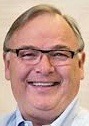


 “New Ford
 Boulevard