
By Jim Hopkins
Boulevard Publisher
The economy was bursting at the seams after World War II, and with wartime conservation over, businesses were churning out consumer goods like never before.
That included electric kitchen mixers, RCA Victor television sets — and every young Louisvillian’s must-have: an analogue sound storage medium in the form of a flat polyvinyl chloride disc with an inscribed, modulated spiral groove.
Yes, we’re talking about records! And the Variety Record Shop at 645 South Fourth St. downtown had them on sale one momentous day in April 1951. These were 78 rpm’s, according to an advertisement the store placed in The Courier-Journal that morning. Intriguingly, Variety was selling sets of 20 “hillbilly records” for $2.98 — no other information supplied.
 That sounds cheap, until you adjust it for inflation: $2.98 in 2016 dollars would be $27.42, according to the Bureau of Labor Statistics inflation calculator.
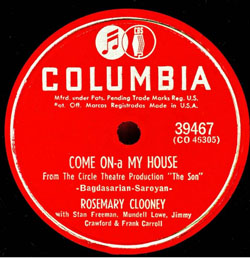
One of the most popular recordings on Billboard’s 1951 chart was Maysville-native Rosemary Clooney‘s “Come On-a My House.” (Listen to it on YouTube.)
What made that April 3 Tuesday so important can only be appreciated in hindsight: The CJ’s front page carried a short, six-paragraph story under a single-column headline about a decision that would soon transform the city’s economy. It was the first word General Electric Co. had picked Louisville for the site of a huge new factory.
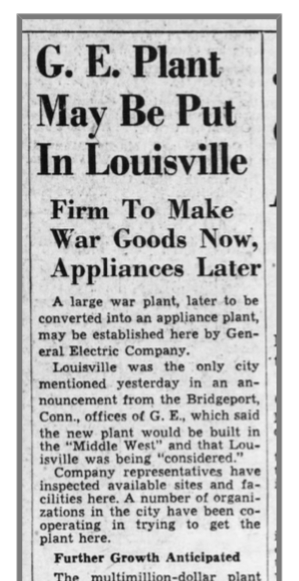
“The multimillion-dollar plant,” the newspaper said, “will be known as ‘Appliance Park,’ Roy W. Johnson, G.E. executive vice president announced. The company believes, Johnson said, the electrical appliance industry will show even greater growth in the future than in the past.”
Indeed, GE built the plant on 1,000 acres in Jefferson County’s south end, eventually employing 25,000 workers at its peak. But employment eventually began to fall: Modern production methods meant more refrigerators could be produced by fewer hands. And then more of the work was shipped to cities and then nations, where labor cost less.
The Appliance Park story hasn’t fully ended; 6,000 people still work there. But the chapter involving GE has; the conglomerate sold its home appliances division and Appliance Park for $5.6 billion to China’s Haier; the deal closed June 6.
 Boulevard