Tag: Vintage Ads

65 years ago: hillbilly music for sale on a historic day

Variety Record Shop
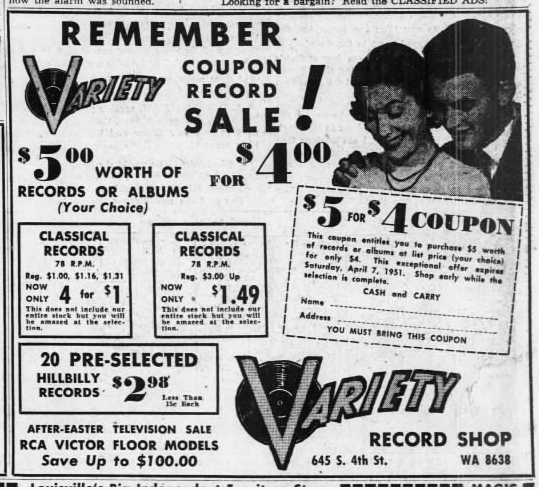
Variety’s ad in the April 3, 1951, Courier-Journal.

By Jim Hopkins
Boulevard Publisher

The economy was bursting at the seams after World War II, and with wartime conservation over, businesses were churning out consumer goods like never before.

That included electric kitchen mixers, RCA Victor television sets — and every young Louisvillian’s must-have: an analogue sound storage medium in the form of a flat polyvinyl chloride disc with an inscribed, modulated spiral groove.

Yes, we’re talking about records! And the Variety Record Shop at 645 South Fourth St. downtown had them on sale one momentous day in April 1951. These were 78 rpm’s, according to an advertisement the store placed in The Courier-Journal that morning. Intriguingly, Variety was selling sets of 20 “hillbilly records” for $2.98 — no other information supplied.
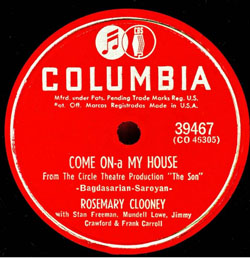
Clooney recordingThat sounds cheap, until you adjust it for inflation: $2.98 in 2016 dollars would be $27.42, according to the Bureau of Labor Statistics inflation calculator.

One of the most popular recordings on Billboard’s 1951 chart was Maysville-native Rosemary Clooney‘s “Come On-a My House.” (Listen to it on YouTube.)

What made that April 3 Tuesday so important can only be appreciated in hindsight: Continue reading “65 years ago: hillbilly music for sale on a historic day”

From baby boom to millennials, GE Appliances’ rise and decline is story of city’s middle class

Boulevard focuses on news about some of Louisville’s biggest employers, nonprofits, and cultural institutions. This is one in an occasional series about them.

Louisville’s economy was sizzling in 1951, when General Electric’s nearly 50-year-old home appliances business started construction on what would become one of the city’s single-biggest factory complexes. Louisville’s population had soared 15% in the previous decade, to 369,000, after World War II’s end shifted the U.S. economy back to peacetime prosperity.

220px-Thomas_Edison2
Edison in 1922.

GE appliances traces its history to 1905. But through its corporate parent and original driving inventor, it really extends even further back, to 1866. That’s when 18-year-old Thomas Edison moved to Louisville to work for Western Union. He spent most of his spare time tinkering, eventually losing his job. Many career moves later, he’d amassed a stack of patents for electrical inventions. The financier J.P. Morgan and a partner cobbled them into a company that formed the basis of General Electric.

That was the goliath that in the late 1940s and ’50s raced to meet post-baby boom consumer demand for toasters, mixers and “white goods” with the latest features — like the two-in-one freezer-fridges advertised in the 1952 TV commercial, top of this page.

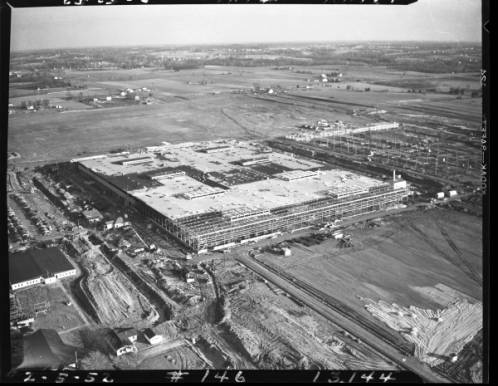
Appliance Park would eventually cover 1,000 acres in the county’s south end, with more than a dozen manufacturing, warehousing and power-generation buildings.

R_13144_01_n
Construction underway on GE Appliance Park in 1952, in this aerial view from the University of Louisville Photo Archives.

With Ford, International Harvester and other big manufacturers, GE launched a solid middle class with good wages and benefits that became the foundation of Louisville’s economy. At one time, the park employed 25,000 workers. It was a self-sufficient city providing many of its own needs, right down to mail handling.

GE women working
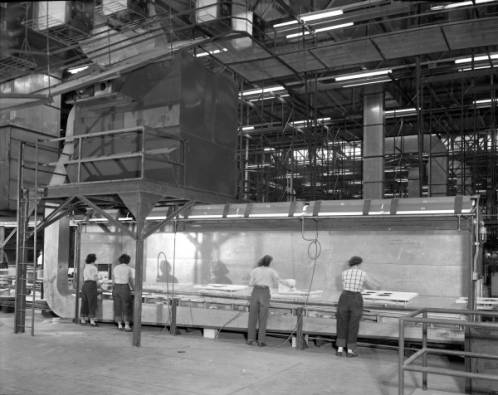
Women work on the pickling and spray booth line in this 1953 photo, also from the photography archives.

Those good times started to ebb in the 1970s, Continue reading “From baby boom to millennials, GE Appliances’ rise and decline is story of city’s middle class”

74 years ago: In a future Ali’s city, a starkly segregated workplace

The world was a very different place on Jan. 17, 1942 — the day Cassius Marcellus Clay Jr. was born on Grand Avenue in Louisville’s West End. Employers were free to discriminate on the basis of sex and race, as these help-wanted ads make clear from that day’s Courier-Journal.

Classified ads

The first ad, for junior stenographers at Louisville City Hospital, was aimed at both white and “Negro” women — and at a good salary, too: $71.50 (a month, no doubt). Adjusted for inflation, that would be equivalent to $1,050 in 2016 dollars, according to the Bureau of Labor Statistics.

In 1942, Odessa Grady Clay was herself a 25-year-old household domestic, who might have sought work in one of these jobs-offered ads. Many years later, of course, she became famous, as the mother of one of the 20th century’s most celebrated sports figures: Muhammad Ali.

City Hospital was at 323 E. Chestnut St., and the building remains there today as part of the University of Louisville Medical School. This is how it looked in 1932, in a photograph from the U of L Photographic Archives.

Louisville City Hospital

76 years ago today: lunch and dinner for under $1

CJ May 29 1940 larger

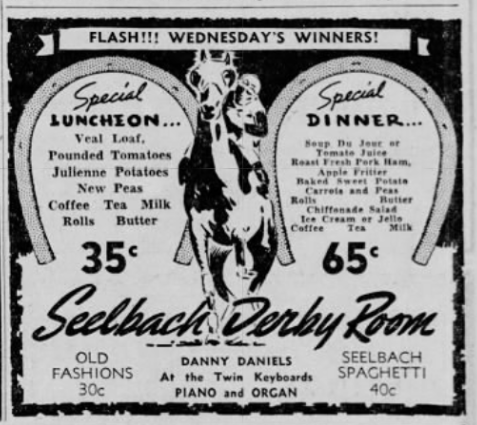
The Seelbach Hotel‘s Derby Room was advertising two Wednesday specials in The Courier-Journal 76 years ago today.

  • Lunch: veal loaf, pounded tomatoes, julienne potatoes, new peas, rolls and butter, plus coffee, tea, or milk for 35 cents.
  • Dinner: soup du jour or tomato juice, roast fresh pork ham, apple fritter, baked sweet potato, carrots and peas, rolls, butter, chiffonade salad, ice cream or jello, plus coffee, tea, or milk for 65 cents.

But wait, there was more: old “fashions” for 30 cents, and Seelbach spaghetti, 40 cents.

Fast-forward to today, and here’s what those prices would look like, adjusted for inflation: Lunch would cost $5.95, and dinner, $11.05. (But probably not at any of the Seelbach’s current restaurants.)

Related: use this inflation calculator from the Bureau of Labor Statistics to compare prices going back to 1913.

62 years ago: Miami-bound in airborne ‘living-room comfort’

Eastern Air Lines ad

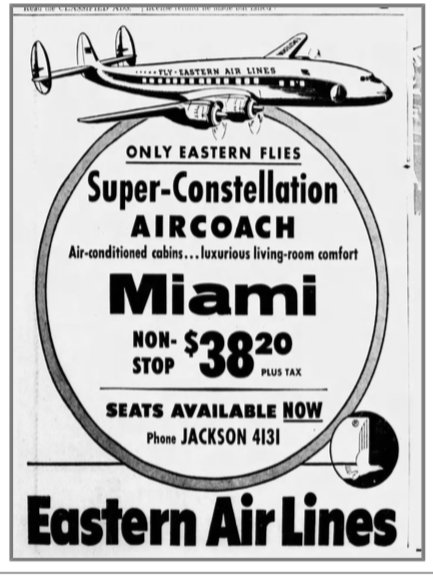
Who wouldn’t want sunny Miami on a chilly late-winter day in 1954, when Eastern Air Lines advertised non-stop flights from Louisville — especially with the promise of both air-conditioned cabins and “luxurious living-room comfort”? And all for just $38.20, plus tax — a sum equivalent to $340 in today’s dollars. But was that a round-trip fare? This ad from the March 5, 1954, Courier-Journal doesn’t say.

Eastern Air Lines, which traced its beginnings to the 1920s, is long gone. Weakened by a strike, higher fuel costs, and unable to compete in a post-deregulated market, the company entered bankruptcy protection in 1989, eventually shutting down at midnight Jan. 19, 1991.

American Airlines is the only carrier currently offering non-stop service to Miami from Louisville. It recently advertised roundtrip tickets for $423.

Related: For those who noticed Eastern’s phone number back then — JACKSON 4131 — here’s a history of telephone exchange names.

90 years ago today: hats off to Louisville’s June brides

Bridal wear

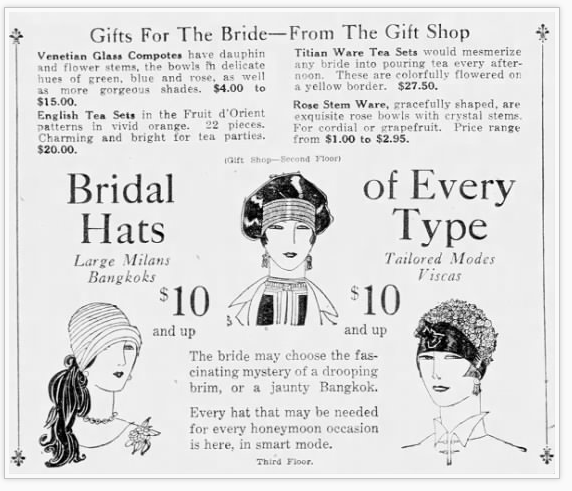
In 1926, exactly 90 years ago today, Kaufman-Straus Co. was advertising bridal gifts at its Fourth Street department store in The Courier-Journal. There were Venetian Glass Compotes ($4 to $15) and Titian Ware Tea Sets ($27.50). Plus, hats with exotic names: Milans, Bangkoks and Viscas, all starting at $10 — a sum equivalent to $135 in today’s dollars.

Kaufman-Straus’ Louisville story began in 1879 and ended, sadly, in 1971. But the flagship building is still at 427-437 South Fourth, now housing offices. The University of Louisville archives includes some wonderful period photos of the department store in its collection of two million photos, manuscripts and other documents.