Tag: The A-list

In newest Dior ads, Lawrence brings star power to style

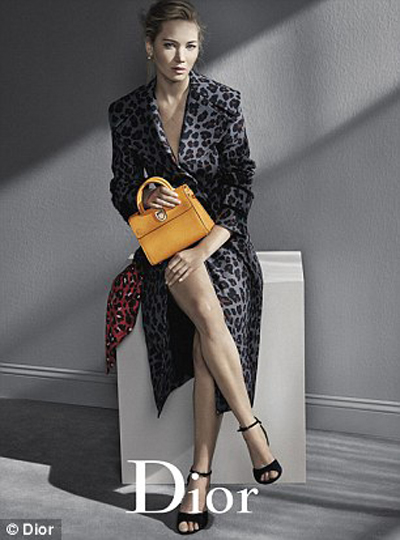
Oscar-winning Louisville native Jennifer Lawrence has been a spokesmodel for Christian Dior since 2012. The legendary French fashion house just released photos for its newest campaign for a fresh line of Diorever bags. (How much are they? Keep reading.)
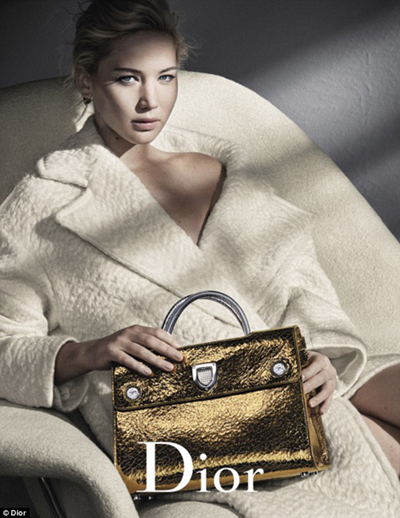
Dior photo one 400

Dior orange purse


Lawrence, 26, just named the world’s highest-paid actress ($20 million alone for December’s sci-fi thriller “Passengers”), says the bags are “chic, stylish and cool,” according to Women’s Wear Daily. Photographer Patrick Demarchelier shot the fall campaign in a New York studio, the trade site reports, with minimal props, gray walls and slanted light casting shadows on Lawrence’s prominent cheekbones and off-the-shoulder cable-knit sweaters.

Lawrence Dior blue bag

Unless Boulevard’s crack fashion editors are mistaken, Dior describes the bag immediately above as one in Midnight Blue prestige calfskin, with the following details:

  • Reversible flap in Imperial Purple smooth calfskin, Cannage topstitching.
  • Silver-tone jewelry.
  • Adjustable strap.
  • Can be carried in the hand or on the shoulder.
  • Dimensions: 30 x 23 x 16 cm, approximately 12 x 9 x 6 inches.

The other bags appear to be so new, Dior hasn’t added them to its online catalog.

What do they cost? If you have to ask . . . actually, you’ve come to the right place! Boulevard believes these are priced around $3,400. Each. That’s according to Spotted Fashion.

But it’s not a Kelly bag

The ladies who lunch in Anchorage, Glenview, Prospect, and other luxe local redoubts will tell you the famous Hermès bag is the only way to go. Once known as the “Sac à dépêches,” it earned its better-known name after another actress, Grace Kelly, gave it a cameo role in an Alfred Hitchcock film. The backstory, according to Wikipedia:
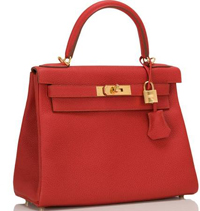
Kelly bag
$21,935 with tax.

“In 1954, Hitchcock allowed the costume designer Edith Head to purchase Hermès accessories for the film ‘To Catch a Thief,’ starring Grace Kelly. According to Head, Kelly ‘fell in love’ with the bag. Within months of her 1956 marriage to Prince Rainier III, the pregnant Princess of Monaco was photographed using the handbag to shield her growing belly from the paparazzi. That photograph was featured in Life magazine.”

Grace Kelly and the Kelly bag
Rainier, Kelly and the bag, about 1956.

Naturellement, you won’t see Lawrence carrying anything near the paparazzi but Dior. Still, given her eye-popping salary, she could well afford any number of Kelly bags, which this year sell for between $10,000 and $20,000-plus.


Related: From Louisville to Monte-Carlo, an $88,000 Memorial Day Weekend.

Follow the money: A trail of footnotes and government documents leads to Insider Louisville’s front door

By Jim Hopkins
Boulevard Publisher

In business journalism, some of the most interesting news shows up in fine-print footnotes in documents companies file with government agencies. Hospital and nursing giant Kindred Healthcare is great example. Last spring in a statement to stockholders, it disclosed two special payments to top executives: $6 million to then-executive vice chairman Paul Diaz in connection with his leaving the CEO’s job, and $250,000 to Chief Financial Officer Steven Farberto help him escape a high-profile dispute with a Glenview neighbor. But to uncover that, you had to follow three different footnotes on a table showing how much they got paid overall.

Insider Louisville logoThis leads me to another footnote, of sorts — one that appeared on a story today at Insider Louisville, the online news site launched in 2010, and to a document I’ve run across at the Securities and Exchange Commission. Together, they open a window on who’s investing in Louisville’s news media at a time when the once-dominant Courier-Journal has been losing influence amid steep staff cutbacks, shifting the balance of power in Kentucky’s biggest city. They underscore the importance of news outlets everywhere telling readers who’s behind the scenes, and about any conflicts of interest owners may pose for their publication. (I’ve got disclosures of my own.)

This morning, at the bottom of a long story about the Humana Foundation, Insider Louisville editors added this disclosure: “One of the five directors of the Humana Foundation is David A. Jones Jr., an investor of Insider Louisville.”

David A. Jones Jr.
Jones

Jones is one of Louisville’s more influential residents. He’s on the board of directors of Humana itself, and his father, David A. Jones Sr., is a co-founder of the insurance giant. Jones Jr. is a partner at Chrysalis Ventures, the Louisville venture-capital firm he founded in 1993, and he’s chairman of the elected seven-person board overseeing the Jefferson County Public Schools. (Here’s Chrysalis’s portfolio of company investments; it doesn’t show Insider Louisville, which suggests this was a personal investment.)

Tom Cottingham
Cottingham

To be sure, close readers of Insider Louisville have known Jones was an investor for several years. In August 2014, owner Tom Cottingham told readers he’d brought in three new minority investors he knew from a prior venture: Jones; Doug Cobb, the former Greater Louisville Inc. CEO, and Jon Pyles, now the site’s vice president of marketing. The story — which carried only a “staff” byline — didn’t say how much they’d invested, nor the exact size of their stake. Cottingham said he remained the majority holder.

Douglas Cobb
Cobb

Now, though, an SEC document filed in April offers more clues about the publication’s investors, whom we learned this summer include a prominent heiress to the glittering Brown-Forman whiskey fortune. I can’t find any mention of the regulatory filing on Insider Louisville’s website, nor in any other media outlet in Louisville. My readers may well correct me after I publish this post; in any case, this is certainly the first time I’m writing about it.

The April 12 document shows that Insider Louisville LLC raised $975,000 from 12 investors in a $1.5 million stock offering that drew the first investment March 31. It didn’t identify the investors by name, however, and it didn’t say how big their stakes were. The first $450,000 was to pay down an undisclosed amount of debt, according to the document; anything left over would go to any of its directors: Jones, Cottingham, and a third named Jamie Wilson. (Who’s Wilson? I haven’t figured that out; maybe one of my readers knows.)

Minimum investment: $25K

Continue reading “Follow the money: A trail of footnotes and government documents leads to Insider Louisville’s front door”

A movie star, a pizza mogul, and a carrot-topped billionaire walk into a bar…

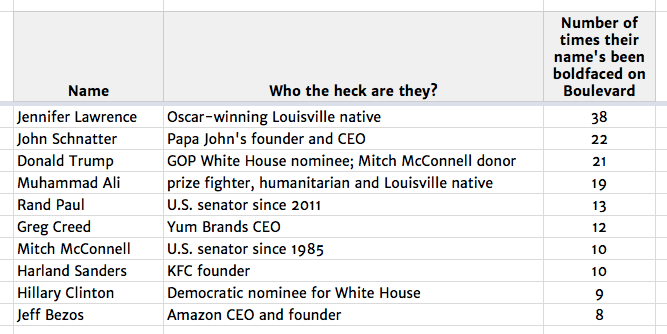
. . . and right onto The Boulevard 400™. It’s our roster of movers, shakers and money-makers, all ranked according to how often their names appear in boldface on Louisville’s most eclectic business and culture news site. This just in! Moments ago, Papa John’s founder John Schnatter edged past Donald Trump into the No. 2 spot behind actress Jennifer Lawrence. Check out the full lineup; here’s a snapshot:

August 31 top 10 Boulevard 400 graphic

The Speed Museum’s new tax return reveals CEO d’Humières’s annual pay ($300K), and a larger window on non-profit finances

By Jim Hopkins
Boulevard Publisher

The Speed Museum is paying CEO Ghislain d’Humières more than $300,000 a year, according to its latest IRS tax return, the first public disclosure of the annual compensation paid to the man hired to lead one of Louisville’s preeminent cultural institutions, after a top-to-bottom renovation completed this year.

Ghislain dhumieres
D’Humieres

D’Humières joined the museum in September 2013 to help oversee the $60 million renovation already underway; it was finished with its reopening in March after being closed more than three years. He came from the Fred Jones Jr. Museum of Art at the University of Oklahoma, where he also was the chief executive.

The tax return says he was paid $290,553 in salary and $18,105 in medical and retirement benefits to run the 91-year-old institution and next year’s $8.3 million budget.

D’Humières replaced Charles Venable, who in October 2012 left for the top job at the Indianapolis Museum of Art. He led the Speed for five years, and was paid $241,834 in salary and $19,250 in benefits during his last year there.

IRS tax returns filed by non-profits such as the Speed provide the fullest annual public accounting of their finances, including spending on payroll, marketing and other overhead as well as revenue from donations and investment income. The Speed’s is especially noteworthy because it’s one of the city’s most high-profile arts organizations, now under d’Humières.

Comparable pay elusive

A native of France, he holds a DEA in History and License of Art History from the University of Paris I Pantheon Sorbonne, and a Master of History from the University of Paris X Nanterre.

It’s difficult to find comparable compensation for Louisville executives in his position, partly because of his unusual academic credentials, but also because IRS tax returns often lag among the city’s handful of non-profits devoted to the arts.

Actors Theatre‘s highest-paid employee, Continue reading “The Speed Museum’s new tax return reveals CEO d’Humières’s annual pay ($300K), and a larger window on non-profit finances”

Slime time: In the genteel world of old-money philanthropy, pizza king Schnatter is busting loose

By Jim Hopkins
Boulevard Publisher

When Tom Jurich chases the money John Schnatter gives to charity every year, it’s the ever-prowling cats that pose competition.

No — not those ones. I’m referring to the snow leopard and other big cats at Louisville Zoo, just five miles from Papa John’s Cardinal Stadium, the University of Louisville colossus about to undergo a $55 million renovation that athletics director Jurich wants done in just two years.

Schnatter, 54, loves U of L. He’s donated more than $20 million to the 22,000-student school over the past decade, winning naming rights for his Louisville-based pizza chain for decades to come. (And Schnatter’s a Ball State graduate, to boot.)

Papa John's logoBut he also likes other charities — especially the zoo, according to the most recent IRS tax returns for his John H. Schnatter Family Foundation, which filed its 2015 return only last week. The returns show the foundation gave $111,000 to the zoo in 2012-2015; only one other recipient — U of L — got more, among the dozens of charities Schnatter and his wife Annette support. And that was on top of $1.1 million they donated to the zoo in 2008. To be sure, the zoo was just barely ahead of No. 3 on the foundation’s gift list (keep reading).
The returns offer an inside look at how one of the city’s richest couples — we’re talking $800 million — positions themselves in a pecking order where the right kind of philanthropy is the ticket to top-drawer society. This much is clear: the Schnatters don’t give a flying fig about old-money Louisville. They’re passing on virtually all the usual suspects: the Speed Museum, Actors Theatre, Kentucky Opera, the Fund for the Arts — cultural war horses favored by more established families like the Browns and their 150-year-old whiskey fortune, or the Binghams and their faded media empire from 1918.

Instead, the Schnatters devoted their relatively modest $1.9 million to 86 charities over the four years I examined, focused heavily on helping children and veterans; animal welfare and — crucially, for anxious development officers — advancing John Schnatter’s growing interest in free enterprise and limited government.

But he’s never been old money, anyway.

1980s: bustin’ out

After graduating from Ball State University in 1983, Schnatter started Papa John’s in a broom closet at his father’s tavern, Mike’s Lounge, which he famously saved from ruin with $2,800 he got selling his prized 1972 Camaro. Nearly 32 years and many millions of pies later, he stars in his own TV commercials blanketing the air, proving he’s not above getting dirty to make a sale — literally. In a Sony Pictures marketing tie-in this summer, he played a slimed Ghostbuster pizza delivery guy; that’s a still photo, top of page. (Can you imagine Brown-Forman Chairman George Garvin Brown IV dressed as a dancing mint julep for an Old Forester spot? Neither can I.)

Tom Jurich
Jurich

No matter. Schnatter’s laughing all the way  to the bank. Today, Papa John’s has more than 4,700 restaurants in 38 countries and territories. Its 22,000 employees include 750 in Louisville. And his stake in the $2.8 billion behemoth just soared past $800 million for the first time. That’s a lot of loot that’s arrived relatively fast. On a split-adjusted basis, Papa John’s stock has increased six-fold in the past five years alone. The question over at U of L: How much of that will Jurich wrangle for his $55 million stadium project? Continue reading “Slime time: In the genteel world of old-money philanthropy, pizza king Schnatter is busting loose”

In Lee and Joan Thomas’ philanthropy, five-star giving without the five-star perks

By Jim Hopkins
Boulevard Publisher

A lot of big philanthropy comes with nice extras: private lunches hosted by ballet company directors; season tickets to the opera with box seats, and trusteeships that offer peerless networking with other A-listers. There’s nothing wrong with that; if you gotta keep the lights on and pay the heating bill, it sometimes takes a carrot or two to attract donors who wear a carat or three.

Image
Thomas

But there are plenty of other worthwhile charities that don’t offer the same social cachet — which leads me to Louisville’s Center for Women and Families, and the late Lee Thomas Jr., the retired businessman and philanthropist who died Tuesday at 90.

The center provides crucial support to victims of domestic violence and sexual assault. It runs a crisis hotline; two emergency shelters, and gives psychological and academic help for kids swept up in all that horror. I have Thomas and his wife Joan in mind because they gave the center $2.6 million last year, the bulk of the nearly $4 million their charitable foundation donated to 32 charities. That’s according to the Joan and Lee Thomas Foundation’s public annual IRS tax return for the year ended June 30, 2015; I leafed through it this morning.

To be sure, other generous Louisvillians give to the center, too. But what’s striking about the Thomas’ giving is the sheer concentration on charities that offer few of the five-star social extras. (KET tote bags don’t count.) This was workaday philanthropy to the Home of the Innocents, the Urban League, Planned Parenthood and other important but hardly glamorous causes; here’s a spreadsheet with all their 2015 donations.

The couple’s humility extended to their foundation’s official name, too, which barely identifies them: It’s simply called the J & L Foundation on charity tracker GuideStar.

Much more to come

Their contributions will no doubt continue; the foundation has a $19.5 million portfolio, enough to throw off nearly $1 million in annual contributions well into the future. Last year’s donations brought to $6.3 million the total given in 2013-2015 alone. It ranks in the top tier of Louisville’s biggest foundations and other non-profits based on asset size.

Vermont American logoThe Thomas’ focus on plain philanthropy is hardly surprising, because it reflects their Quaker faith; several of their other donations last year were to charities associated with the Friends General Conference.

Lee and Joan met at a Quaker work camp in 1948, The Courier-Journal says in his obituary. After marrying and moving to Louisville, in 1954 he started building up the former American Saw and Tool Co. — later called Vermont American Corp. — from a single-product supplier to Sears Roebuck & Co. into an international public corporation employing 5,000 people. It’s now a brand in the Robert Bosch Tool Co.

The Thomas’ were instrumental in establishing the ACLU’s Kentucky chapter in 1955, when local civil rights activists were defending a couple, Carl and Anne Braden, accused of being treacherous union sympathizers who fought racial segregation in housing. Lee Thomas also marched with the Rev. Martha Luther King Jr. in the city.

The ACLU mourned his death. “He put up the seed money to get our affiliate off the ground and continued to support our work for the next 61 years,” the chapter said on its Facebook page. “He was a giant for peace, justice, and equality for all. He will be missed, but his example will continue to inspire.”


Disclosure: I’m a card-carrying ACLU member and Planned Parenthood supporter.