Yum is officially headquartered in Louisville, but its corporate HQ is actually a three-hour flight away, in Raleigh, N.C.
In a new filing with the Securities and Exchange Commission today, Yum said it made an important amendment to its corporate bylaws that now requires disputes between shareholders and the company be handled in North Carolina’s court system.
Why that state? Because, even though Yum is headquartered in Louisville — and the top brass works part of the time in suburban Dallas — the company itself is incorporated in North Carolina, where the fast food giant’s principal office is in Raleigh. (Of course, that office might be little more than a mailbox drop.) Adding a little confusion, the specific court is actually 167 miles away, in Mecklenburg County’s Charlotte.
Meister
The SEC filing doesn’t say what prompted the company to choose the N.C. court system. But it follows a high-profile dispute between dissident stockholder Keith Meister of Corvex Management that ended last fall when he was given a seat on the board of directors. Corvex had built up a 5% stake to press the company into spinning off its flagging China Division, a step it’s planning to complete by Oct. 31.
She received the shares in the form of SARs — or stock appreciation rights — under the executive compensation plan, for the equivalent of $38.43 each, or a total $581,000. So, her pre-tax net was about $919,000.
Those employers’ shares closed higher today, as overall U.S. stocks clawed back half the ground lost after Britain’s surprise vote Thursday to quit the European Union. It was the second rally in two days on Wall Street, which had been rattled since Friday by uncertainty over the so-called Brexit. Britain’s stock market also has recouped losses in the same stretch, although other major markets in Europe and Asia have yet to bounce back fully, according to The Associated Press.
AMAZON: Walmart today launched a free 30-day trial of ShippingPass, its two-day shipping program to all U.S. consumers, as the world’s biggest retailer ratchets up the competition with Amazon’s Prime subscription service. ShippingPass costs $49 a year, half as much as Amazon’s $99 (Reuters and press release). Also today, Amazon slashed prices up to 50% on newly released, full-featured, unlocked Android smartphones for Prime members (company website). Amazon employs 6,000 workers in the Louisville area, at distribution centers in Jeffersonville, and in Bullitt County’s Shepherdsville.
KINDRED: Senior Vice President John Lucchese sold 4,341 shares for about $11.39 a share today for a total $49,000, the company said in a Form 4 regulatory filing (SEC document). Kindred shares closed this afternoon at $11.43, up 5%.
GE: U.S. regulators rescinded stricter oversight of the company’s finance arm, GE Capital, after saying the conglomerate had made changes that significantly reduced its threat to U.S. financial stability (Wall Street Journal). Its former residential home appliance business, now owned by Haier Group, employs 6,000 workers in Louisville.
Yarmuth
In other news, U.S. Rep. John Yarmuth of Louisville has once more donated his entire congressional salary — $174,000 — to charity, making good on a campaign promise when he was first elected a decade ago. The 17 recipients include three arts and humanities groups: Louisville’s Fund for the Arts, Louisville Orchestra, and the Muhammad Ali Center (WDRB).
Those 10 companies tracked by Boulevard joined U.S. stocks clawing their way back from two consecutive days of steep losses, following Britain’s stunning vote last week to quit the European Union. The Dow Jones Industrial Average closed moments ago at 17,410 — up 1.6%; the broader S&P 500 index jumped 1.8% to 2,036 points, and the Nasdaq climbed 2.1% to 4692.
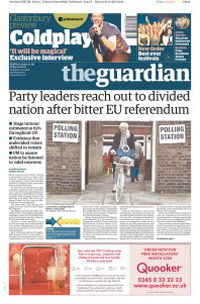
Today’s Guardian.
“This is going to take a long time to play out and I think the initial shock is being a little reversed right now,” Doug Cote, chief market strategist at Voya Investment Management told CNBC. “This is not 2008. It’s more like 2011.” (Read the latest Brexit developments in Britain’s Guardian.)
In Louisville, virtually all of Boulevard’s top 10 rose by the time markets closed at 4 p.m. They included Kindred, which got pounded yesterday, falling 7%. The closing prices:
Those gains came even as Ford said itexpects the double-whammy of any softer post-Brexit industry and a weaker British sterling “would have an adverse impact on our operations in the long term,” a Ford spokesman told financial news site The Street. Ford also said it would issue revised 2016 guidance during its second-quarter earnings call July 28 (The Street). Ford shares have now tumbled nearly 8% since Britain’s surprise vote to leave the European Union — nearly twice as much as the broader S&P 500 index.
In its most recent annual report, in February, Ford warned about the impact of a possible Brexit, saying it “could cause financial and capital markets within and outside Europe to constrict, thereby negatively impacting our ability to finance our business, and also could cause a substantial dip in consumer confidence and spending that could negatively impact sales of vehicles.”
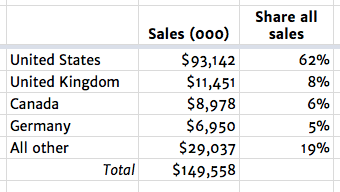
Last year, the U.K. was Ford’s single-biggest market after the U.S., accounting for 8% of the automaker’s $149.6 billion in sales:
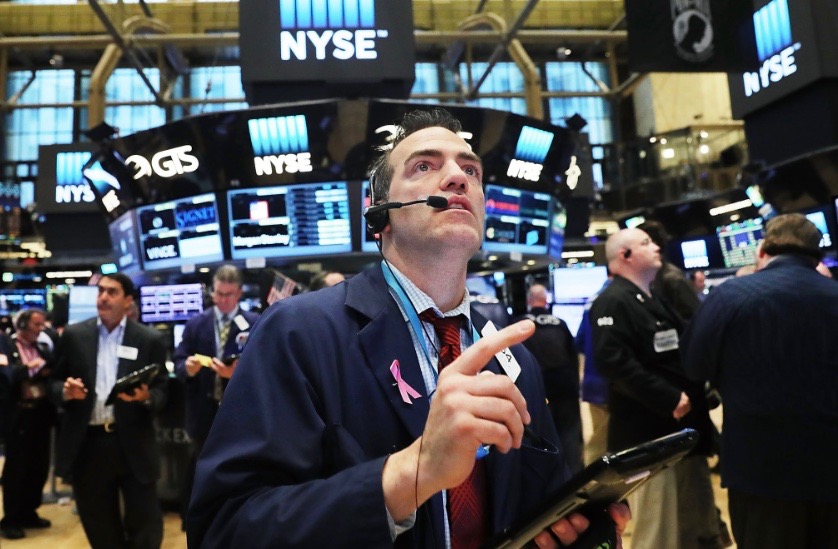
Anxious traders at the New York Stock Exchange today (New York Times).
The Dow Jones Industrial Average cratered 3.3% this afternoon, tumbling 589 points and wiping out its year-to-date gains as fears gripped markets with Britain’s stunning vote to leave the E.U. The broader S&P 500 tumbled 3% and the Nasdaq slumped 3.8%. Latest news.
All 10 big-employer stocks tracked by Boulevard fell sharply:
To fully appreciate the magnitude of the losses, consider Kentucky’s richest family, the Browns of Brown-Forman. They saw $201 million of their more than $6 billion in paper wealth evaporate in a matter of hours.
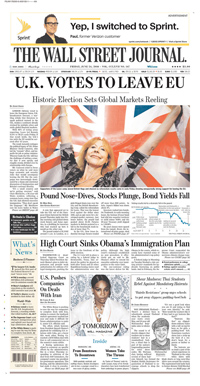
This morning’s paper.
The impact of last night’s stunning Brexit news for Louisville employers will be greatest for those with extensive overseas footprints and currency exposure.
They include Brown-Forman, which sells 15 brands such as Jack Daniel’s in 160 countries worldwide. The U.K. is the company’s second-biggest market, accounting for 10% of fiscal 2016 sales, according to Brown-Forman’s annual report. Europe, excluding the U.K., was 21%. The U.S. is No. 1, with 46%. The company says foreign markets are increasingly important: “In fiscal 2016, we generated 54% of our net sales outside the United States compared to 41% 10 years ago.”
Other companies likely taking post-Brexit hits include Papa John’s, which operates in 39 countries; Yum in 130 countries and now reshaping overseas operations with a planned China spinoff in October; Ford, which is already reworking its European sales strategy, and Amazon, a relative newcomer abroad.
Boulevard’s Stock Portfolio companies routinely warn investors about risks of doing business outside the U.S. Papa John’s, for one, noted in its annual report that “international operations could be negatively impacted by changes in international economic, political, security or health conditions in the countries in which the company or our franchisees operate.”
Yum’s 14,600-unit KFC Division bears the biggest overseas exposure; it’s in 120 countries, with more than a third — 5,003 restaurants — in China.
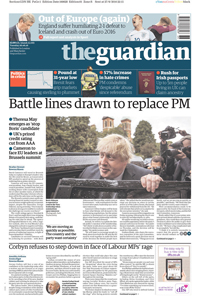
Britain’s Guardian.
“Our business,” Yum says in its annual report, “is increasingly exposed to risks inherent in international operations. These risks, which can vary substantially by country, include political instability, corruption, social and ethnic unrest, changes in economic conditions . . . as well as changes in the laws and policies that govern foreign investment in countries where our restaurants are operated.”
Also, Yum warns, “results of operations and the value of our foreign assets are affected by fluctuations in currency exchange rates, which may adversely affect reported earnings.”
Boulevard’s Big 10 companies employ 63,000 workers in the Louisville area, and nearly 2 million worldwide.
Brown-Forman and other publicly traded companies file an annual report with the Securities and Exchange Commission that includes reams of facts, figures and other information. An essential section describes the business itself. This morning, the company filed its latest report; here’s the passage, slightly edited:
“Brown-Forman Corp. was incorporated under the laws of the State of Delaware in 1933, successor to a business founded in 1870 as a partnership and later incorporated under the laws of the Commonwealth of Kentucky in 1901. We primarily manufacture, bottle, import, export, market, and sell a wide variety of alcoholic beverages under recognized brands. We employ over 4,600 people on six continents, including about 1,300 people in Louisville, home of our world headquarters. We are the largest American-owned spirits and wine company with global reach. We are a ‘controlled company’ under New York Stock Exchange rules, and the Brown family owns a majority of our voting stock.”
The company also published a summary of its brands:
“Beginning in 1870 with Old Forester Bourbon Whisky — our founding brand — and spanning the generations since, we have built a portfolio of more than 40 spirit, wine, and ready-to-drink cocktail brands that includes some of the best-known and most-loved trademarks in our industry. The most important brand in our portfolio is Jack Daniel’s Tennessee Whiskey, which is the fourth-largest spirits brand of any kind and the largest American whiskey brand in the world, according to Impact Databank’s ‘Top 100 Premium Spirits Brands Worldwide’ list.”
Related:Fresh details emerge about the Brown family’s multibillion-dollar stake in the company now led by Chairman George Garvin Brown IV.
News about business and culture in Louisville, Ky.




 “Beginning in 1870 with Old Forester Bourbon Whisky — our founding brand — and spanning the generations since, we have built a portfolio of more than 40 spirit, wine, and ready-to-drink cocktail brands that includes some of the best-known and most-loved trademarks in our industry. The most important brand in our portfolio is Jack Daniel’s Tennessee Whiskey, which is the fourth-largest spirits brand of any kind and the largest American whiskey brand in the world, according to Impact Databank’s ‘Top 100 Premium Spirits Brands Worldwide’ list.”
 Boulevard