The University of Louisville and other public colleges have built the biggest endowments, but are nonetheless lagging other, often smaller institutions in annual investment returns, according to a new report today by the Kentucky Center for Investigative Reporting. For its report, the center examined five years’ worth of investment returns of 11 endowments statewide.
Only 10 years ago, just 3% of the internments at storied Cave Hill Cemetery involved cremations. Today, the cemetery estimates the rate has soared to 37%. The statewide rate is lower: 22%, but across the U.S., it’s nearly 47%.
No wonder. A traditional funeral in the U.S. costs $8,000 to $10,000, with the single-biggest expense being a casket, averaging $2,300 — a pricey item cremation doesn’t require. Urns for ashes, on the other hand, are a lot cheaper, such as the $139.95 one pictured, left.
The cemetery’s more famous permanent residents include KFC founder Harland Sanders.
The recently completed Speed Art Museum‘s expansion included a first-ever 142-seat cinema equipped with state-of-the-art technology. This weekend’s film, “The First Monday in May,” is about the Metropolitan Museum of Art’s Met Gala, an annual event that’s surged in popularity under the direction of top Vogue magazine editor Anna Winter. It got a 79% on movie review aggregation site Rotten Tomatoes.
Cherokee Park visitors at Hogan’s Fountain in 1920.
Frederick Law Olmsted died 113 years ago this August, so we can only imagine what he’d think of the emerald necklace of parks and parkways his famous New York firm designed for Louisville. Olmsted visited the city in 1891 at the invitation of prominent citizens with newly acquired land reserved for parks; he was 69 years old, and well into a second career (first one: newspaper reporter).
Louisville was flexing its big-city muscles at a time of huge population growth. The Southern Exposition of 1883-87 in what is now Old Louisville had shined a spotlight on the city — an electric one, in fact. One of the exposition’s top draws was the largest to-date installation of Thomas Edison’s incandescent light bulbs, to illuminate the exposition at night. (Edison had lived in Louisville 16 years before.) By Olmsted’s arrival, the city had 161,129 residents, a 60% increase in just the two decades after the Civil War.
The parks project ultimately grew to 18 parks and six parkways, public green space that links Louisville to one of Olmsted’s most famous works: Central Park in New York. (And, indeed, we have our own Olmsted-designed Central Park, in Old Louisville.) Much of the work was certainly executed by Olmsted’s firm, rather than the man himself. Tragically, just four years after he visited Louisville, senility forced Olmsted to retire. He died in 1903 at McLean Hospital in suburban Boston, originally an asylum for the insane.
This morning, we heard Olmsted’s history retold when several hundred people crowded into an auditorium on the Bellarmine campus for the Olmsted Park Conservancy‘s annual fundraising breakfast. Mimi Zinniel, the group’s CEO, runs a tight ship: The event’s notice promised Heine Bros. coffee and a chance to network from 7:30 until 8, when the program would start promptly, concluding by 9. This made sense, because most of the attendees would soon be on their way to work. Nearing 8, the din of so many people talking at once was amplified by the cavernous space, which looked like a basketball court, minus hoops, but with dozens of linen-topped round tables. On the menu: yogurt parfait with granola and fresh blueberries, and quiche Lorraine.
The speakers’ remarks were mercifully short and to the point, with videos adding entertaining pizzazz; one featured children and parents proclaiming which parks were their favorite. But the video drawing the most cheers came midway through. It starred retiring Metro Council member Tom Owen, whose district includes one of the biggest and best-known: Cherokee Park in the Highlands. Owen’s just-elected successor, Brandon Coan, wore a cream-colored suit and greeted well-wishers. Boulevard complimented him on his campaign’s financial efficiency — spending just $18 per vote vs. the $63 spent by the No. 2 finisher, Stephen Riley. Coan protested, but only mildly: “Actually, I think it was closer to $13.”
Olmsted
Squint your eyes a bit — well, a lot — and Owen bears a passing resemblance to Olmsted. Some of that’s the white beard, and age: Owen is now 76. Like Olmsted, he’s all about the outdoors, famously getting about the city on bicycle in a fluorescent-green safety vest. And that’s how he appeared in the video: touring the Olmsted parks as he told their history (history-telling being his other job, after all). Concluding his tour, Owen didn’t miss a chance to plug one of the fundraiser’s main sponsors.
“Now,” he said, “I’m going to pedal off and get a special cup of Heine Bros. coffee.” Cue applause.
Big smiles, big personalities and big business networking — yes, it’s everyone’s favorite feature in the society shiny sheets: party photos! Boulevard picks through the pics, choosing our favorite coverage. Today’s entry is from Nfocus Louisville.
Napier’s nattier.
Long Run Hounds Hunt Ball
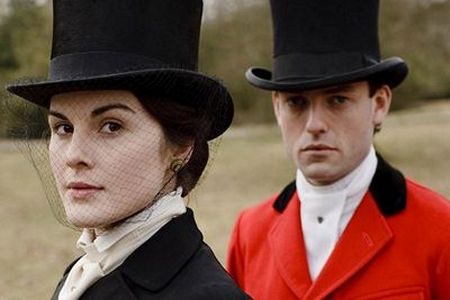
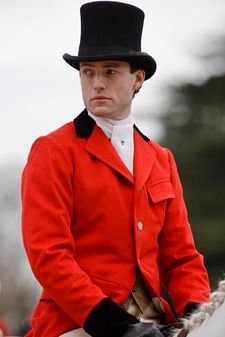
“The invitation,” Tonya Abeln writes, “eloquently stated the dress code as ‘White or Black Tie — Scarlet, if convenient,’ and for most of the members, their scarlet riding frock, designed as a bright form of identification as well as to denote a seasoned Hunt member, was the perfect dapper ensemble.”
In other words, picture “Downton Abbey’s” HonorableEvelyn Napier, looking askance in the photo, above right.
Annette Adams chaired the party at the Pendennis Club, where a silent auction was all about some serious and even mysterious paraphernalia: vintage English lapel pins, hunt bridle (?) and breastplate (?!).
Lest readers blanch at the thought of tearing a fox to pieces, not to mention the traditional “blooding” procedure, Nfocus urged calm: “Foxhunting could more accurately be called fox chasing, as LRH is one of many ‘no-kill’ hunt clubs, indulging in the sport purely for the enjoyment of the outdoors with their four legged friends.”
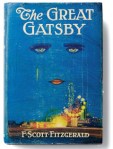
F. Scott Fitzgerald’s best-known novel chronicles the star-crossed romance between Louisville debutante Daisy Fay Buchanan and a local soldier, the future tycoon Jay Gatsby. In this passage, her friend Jordan Baker is recalling their Louisville childhood among the well-to-do gentry, living in mansions ringing verdant Cherokee Park in 1917.
Daisy Fay was just 18, two years older than me, and by far the most popular of all the young girls in Louisville. She dressed in white, and had a little white roadster, and all day long the telephone rang in her house and excited young officers from Camp Taylor demanded the privilege of monopolizing her that night.
She had a début after the Armistice, and in February she was presumably engaged to a man from New Orleans. In June, she married Tom Buchanan of Chicago, with more pomp and circumstance than Louisville ever knew before. He came down with a hundred people in four private cars, and hired a whole floor of the Seelbach Hotel, and the day before the wedding he gave her a string of pearls valued at $350,000.*

 No wonder. A traditional funeral in the U.S.

 F. Scott Fitzgerald’s
  Boulevard