The Courier-Journal’s Muhammad Ali news coverage immediately after the prize fighter died near midnight on June 3 was more than a decade in the making, the paper’s editor said today, in an inside account of how it came together. The New York Times literally stopped the presses to get the news in print. The Louisville native was buried in Cave Hill Cemetery amid a celebrity-studded memorial service after he died in Phoenix following a decades-long battle with Parkinson’s disease; he was 74.
The economy was bursting at the seams after World War II, and with wartime conservation over, businesses were churning out consumer goods like never before.
That included electric kitchen mixers, RCA Victor television sets — and every young Louisvillian’s must-have: an analogue sound storage medium in the form of a flat polyvinyl chloride disc with an inscribed, modulated spiral groove.
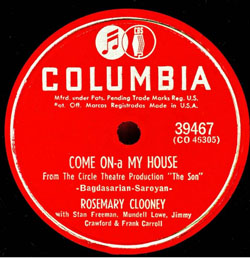
Yes, we’re talking about records! And the Variety Record Shop at 645 South Fourth St. downtown had them on sale one momentous day in April 1951. These were 78 rpm’s, according to an advertisement the store placed in The Courier-Journal that morning. Intriguingly, Variety was selling sets of 20 “hillbilly records” for $2.98 — no other information supplied.
“We took what in today’s light is an oddly hostile approach on the specific issue of Ali’s name, which did little to help race relations in a turbulent time.”
— The Courier-Journal, in an unsigned editorial this morning, belatedly apologizing for the newspaper’s waiting so long to use Muhammad Ali’s adopted name, after he rejected the one given at birth: Cassius Clay.
The editorial followed a New York Times article Thursday, pointing out this failing on the part of many papers, the Times included. The Louisville paper’s apology is certainly welcome. But was it prompted by the Times story? Or was it already in the works?
Worth noting: In a search this week, the first “Ali” reference Boulevard could find in the CJ’s online database was a page-one story in 1969, five years after he’d chosen the new name. But that’s incorrect; “Ali” appears the year he adopted it — 1964 — although editors didn’t take it seriously until many years later.
The Courier-Journal’s first reference to Ali by his chosen name didn’t come until 1969, five years after he adopted it.
Shortly after he defeated Sonny Liston to win the heavyweight title in February 1964, Cassius Clay changed his name to Muhammad Ali. The new name, bestowed by Nation of Islam leader Elijah Muhammad, “was important to Ali, who referred to Cassius Clay as his slave name and took umbrage when people used it,” The New York Times says in a new story.
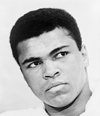
Ali in 1967.
But in The Courier-Journal, the Times, and many other papers and magazines, “Cassius Clay won the Liston rematch in 1965, Cassius Clay beat Cleveland Williams in 1966, and Cassius Clay refused to be inducted into the Army in 1967.”
Indeed, the earliest CJ reference to the late Louisville native by his chosen name didn’t come until Aug 24, 1969, when the paper’s Bill Petersen interviewed him in Chicago, according to a search this morning of the CJ archives in Newspapers.com. At the time, Ali faced five years in prison and a $10,000* fine after his 1967 draft evasion conviction; on appeal, the U.S. Supreme Court eventually threw it out. (Correction: In fact, the CJ used “Ali” as early as 1964, the year he adopted it; please read this new post.)
Under a Page One headline that said, “Going to Jail for Beliefs Appeals to Cassius, Deposed Champ,” Peterson wrote: “The mature Muhammad Ali — Cassius Clay, if you prefer — looked good. He was still [lightning] fast. His shoulders and biceps were immense. His stomach was flat.”
Ali died last week in Phoenix, his primary home, after battling Parkinson’s disease for decades; he was 74. He will be buried at Cave Hill Cemetery today.
* $65,000 in 2016 dollars, according to the Bureau of Labor Statistics inflation calculator.
A news summary, focused on big employers; updated 5:30 p.m.
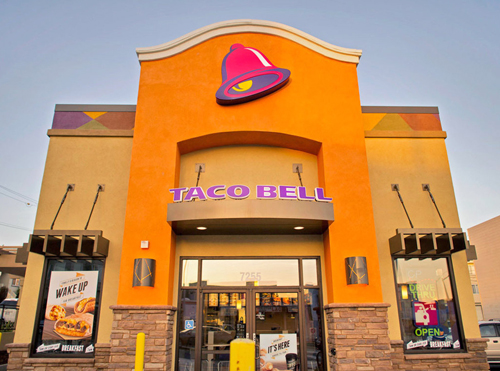
Taco revamped menu this year to include breakfast.
TACO BELL ranked No. 2 among fast-casual Mexican restaurants in the annual Harris Poll restaurant brand survey, published today, right behind Moe’s Southwest Grill. Last year, the Yum unit tied for No. 3. Meanwhile, Chipotle — hit hard this year by stubborn health scares at some restaurants — got knocked down to No. 5; it had topped the list the past three years (Harris). Moe’s is owned by the same company that operates shopping mall mainstays Auntie Anne’s and Cinnabon. (USA Today).
In horrific allegations in Houston, three teenagers say Taco Bell employees stabbed one of them, then burnt the other two with hot grease — accusations the company disputes (CW 33and Houston Chronicle). And in Wisconsin, a 25-year-old Village of Waterford man is facing the possibility of more than three years in prison after allegedly passing out in the drive-thru of a Waukesha Taco Bell last week and physically refusing arrest (Journal Times).
McShane
BROWN-FORMAN said Michael McShane, a senior vice president overseeing the Australia, New Zealand, and Southeast Asia regions, is retiring Oct. 31. The spirits and wine giant didn’t disclose details about replacing him. McShane’s 17-year career started in 1999 as finance director for Brown-Forman Beverages based in Sydney after serving in a variety of roles for Swift & Moore, then distributor for Brown-Forman in Australia (press release). Also, a transcript is now available for the company’s fourth-quarter earnings conference call yesterday (Seeking Alpha).
YUM has set Oct. 31 as the date it plans to formally split itself into two publicly traded companies when it cleaves the mammoth China division away under pressure from activist investor Corvex Management. CEO Greg Creed said yesterday his team would begin a road show in early October to pitch the split to prospective investors (The Street). Yum shares closed at $83.73, down less than 1%.
Lynch
HUMANA: Aetna president Karen Lynch told analysts at a Goldman Sachs health care conference the Hartford insurer is giving the Justice Department “a lot of information” in response to a second request, amid the agency’s review of the planned $37 billion acquisition of Humana. But she didn’t detail the nature of the agency’s additional request. Lynch said the deal still remains on track to close later this year (Hartford Courant).
TEXAS ROADHOUSE shares closed at $46.54, up 15 cents, after hitting an intraday high of $46.81. It was the second consecutive day shares closed at an all-time high. The casual steak house chain’s stock has soared 27% in the past year vs. a slim 1% gain in the S&P 500 index (Google Finance). Since opening in 1993, the company has grown to more than 460 locations in 49 states and five international locations in the Middle East (company fact sheet).
GE will pay eligible workers a “closing payment” of $800 following the $5.6 billion sale of the company’s home appliances business to China’s Haier. Also, those who lose jobs within the first year after the sale will get preferential placement at other GE locations. The sale closed Monday, ending a 61-year chapter in Louisville’s economic history. The IUE-CWA union and Haier have agreed to honor terms of the current contract with about 6,000 Appliance Park workers while a new one is being negotiated (WDRB). Monday’s sale also included GE’s 1,200-employee refrigerator factory in Decatur, Ala. (Decatur Daily News). Haier and other Chinese multinationals setting up factories in the U.S. are attracted to America’s stable social, political, and legal environments. Haier completed its $5.6 billion acquisition of GE Appliances on Monday, part of a wave of such investments totaling more than $15 billion last year (Rutgers University).
UPS: Prosecutors in Las Vegas have dropped charges against a paraplegic man accused May 21 of robbing a UPS driver of a cellphone and scanner, and then running from the scene, conceding his disabilities would have made that impossible. But the prosecutor’s move didn’t come until after Antwine Hunter spent two weeks in jail (Review-Journal).
Callaway
In other news, in a move with big implications for The Courier Journal, the top editor at USA Today, David Callaway, is leaving to become CEO of financial news site The Street, effective July 1; the paper has started a search for his replacement (USA Today).
Boulevard reports extensively on executive pay at big local employers. But we also look at what folks make down in the trenches — and behind those huge commercial espresso machines. This is from a recent ad in The Courier-Journal’s help-wanted section for Louisville.
The duties: If you guessed, make “coffee.” Or even, make one of those obnoxious Starbucks orders, like a “venti, half-whole milk, one-quarter 1%, one-quarter non-fat, extra-hot, split-quad shots, no-foam latte, with whip, two packets of Splenda, one sugar-in-the-raw, a touch of vanilla syrup, and three short sprinkles of cinnamon” — well, you’d still be off.
The Seattle-based purveyor of coffee culture says being a barista actually means “contributing to Starbucks success by providing legendary customer service.” Of course, it’s not all that vague. You’ll need to
Maintain a calm demeanor during periods of high volume or unusual events to keep the store operating to standard and to set a positive example for the team.
On the other hand, some of it does sound awfully touchy-feely/New Age-y. For example, be prepared to
Anticipate customer and store needs by constantly evaluating customers for “cues.” You’ll need to pass along that information to a manager so the team can respond as necessary to create the required “Third Place” environment.
Ditto for
Recognizing “alarms,” or changes in co-worker morale and passing that along, too.
Perhaps most surprising to anyone who’s visited a Louisville Starbucks recently, there really is a limit to what you can wear, because the dress code
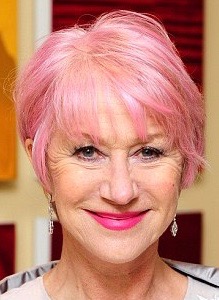
Prohibits displaying tattoos, piercings in excess of two per ear, and unnatural hair colors, such as blue or pink.
What it pays: Maddeningly, the ad doesn’t post this most important information. But employment site Glassdoor reports the nationwide average for Starbucks baristas is $9.42 an hour. Working 20 hours a week, 52 weeks a year, you’d make about $9,800, before taxes.
Related: You say “barista,” we say “baristo” — or do we?
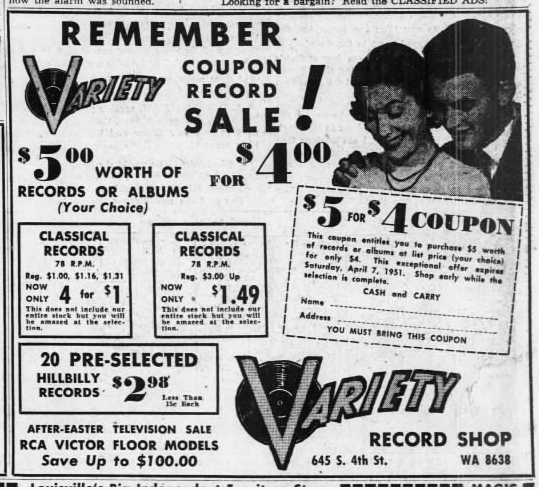
 That sounds cheap, until you adjust it for inflation: $2.98 in 2016 dollars would be $27.42, according to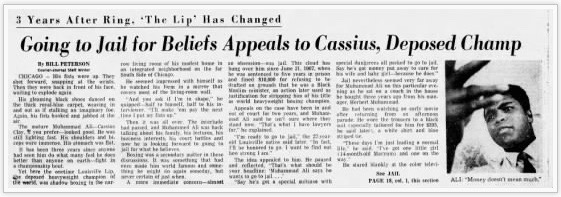


 GE will pay eligible workers a “closing payment” of $800 following the $5.6 billion sale of the company’s home appliances business to China’s Haier. Also, those who lose jobs within the first year after the sale will get preferential placement at other GE locations. The sale closed Monday, ending a 61-year chapter in Louisville’s economic history. The IUE-CWA union and Haier have agreed to honor terms of the current contract with about 6,000 Appliance Park workers while a new one is being negotiated (
 Boulevard reports extensively on
  Boulevard