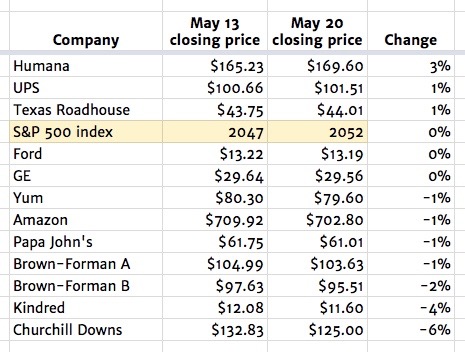
Shares of big employers in the Boulevard Stock Portfolio, ranked by weekly performance at today’s closing price, with the S&P 500 index for comparison.
Related: More news about U.S. stocks.
Shares of big employers in the Boulevard Stock Portfolio, ranked by weekly performance at today’s closing price, with the S&P 500 index for comparison.
Related: More news about U.S. stocks.
“Why would anyone in their right mind want to stay in a city and state that could easily be described as hell on earth?”
— a Hartford Courant reader, commenting on whether Aetna might relocate its headquarters after the insurer completes its purchase of Humana.
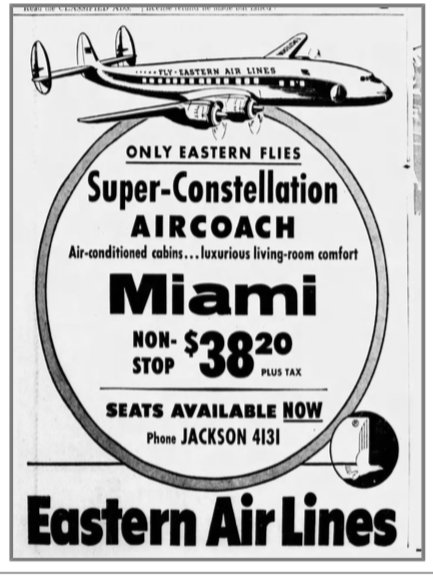
Who wouldn’t want sunny Miami on a chilly late-winter day in 1954, when Eastern Air Lines advertised non-stop flights from Louisville — especially with the promise of both air-conditioned cabins and “luxurious living-room comfort”? And all for just $38.20, plus tax — a sum equivalent to $340 in today’s dollars. But was that a round-trip fare? This ad from the March 5, 1954, Courier-Journal doesn’t say.
Eastern Air Lines, which traced its beginnings to the 1920s, is long gone. Weakened by a strike, higher fuel costs, and unable to compete in a post-deregulated market, the company entered bankruptcy protection in 1989, eventually shutting down at midnight Jan. 19, 1991.
American Airlines is the only carrier currently offering non-stop service to Miami from Louisville. It recently advertised roundtrip tickets for $423.
Related: For those who noticed Eastern’s phone number back then — JACKSON 4131 — here’s a history of telephone exchange names.
The fast-casual restaurant chain’s Securities and Exchange Commission filing this morning shows stockholders grew slightly more happy with last year’s executive compensation vs. the prior year. The breakdown of the advisory vote at yesterday’s annual meeting vs. last year’s meeting:


Chairman and CEO Kent Taylor got paid $8.6 million last year, according to Boulevard’s executive compensation survey. That was way up from 2014, when he got $1.1 million, because of a huge $7.4 million stock grant.
Here’s the year-ago SEC filing on the vote.
The tweet sent before yesterday’s annual meeting; more company tweets:
A news summary focused on big employers; updated 3:53 p.m.

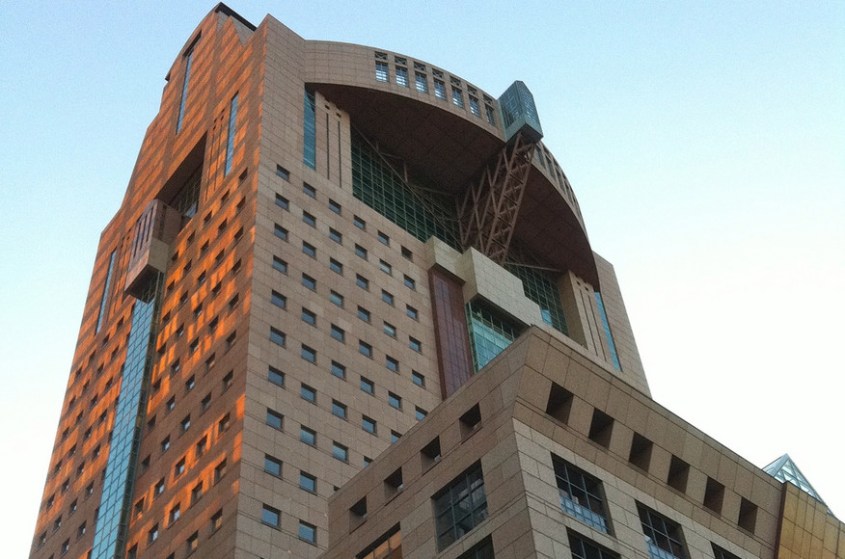
HUMANA: Aetna’s CEO did little today to allay concerns the insurance giant might leave its historic Hartford home after its workforce doubles to 110,000 with the pending Humana merger. Mark Bertolini told the annual stockholders meeting that Aetna was required to establish a Kentucky presence when it sought to buy Humana. “Having said that,” he told shareholders, “the rest of all of our real estate is under review.” He expects the $37 billion deal to close in the second half of the year. (Hartford Courant). Humana’s stock closed at $169.60 a share, up less than 1%, but enough to make it the best-performing stock this week among Boulevard’s portfolio of big local employers.
GANNETT: Tribune Publishing is reportedly turning the tables on Gannett by planning a hostile offer to buy the owner of The Courier-Journal, USA Today and more than 100 other dailies. “I am going to bid on Gannett,” CEO Michael Ferro told five dozen Los Angeles Times staffers, according to a confidential source. “I have lawyers working on it.” That would counter Gannett’s sweetened all-cash offer this week, to $15 a share, or about $475 million, excluding $385 million of outstanding debt (Politico Media).
UPS CEO David Abney doubts package delivery by drone will be as ubiquitous as some forecast. Speaking to a Boston business conference, he said: “I don’t believe there are going to be 10,000 to 20,000 of these flying over metro Boston delivering dog food and toothbrushes. I just don’t believe the economics of those work out” (Boston Business First).
AMAZON, which is developing Prime Air to transport packages to customers within 30 minutes via drone, could learn something from DHL’s drone delivery program (Business Insider).
PAPA JOHN’S: Baseball-related pizza promotions are now so pervasive, they extend to the local level, thanks to Papa John’s status as the “official pizza” of 22 big league clubs (538).
BROWN-FORMAN is now offering pregnant employees 12 weeks’ paid leave, about twice as much as the most generous maternity leave plans of the area’s 10 biggest employers (Insider Louisville).
CHURCHILL DOWNS: Which horses stand the best chances at tomorrow’s 141st Preakness Stakes (New York Times).
In other news, presumptive GOP White House nominee Donald Trump addresses the 70,000-member NRA annual meeting today at the Kentucky Exposition Center (NBC).
This just in:

Frederick Law Olmsted died 113 years ago this August, so we can only imagine what he’d think of the emerald necklace of parks and parkways his famous New York firm designed for Louisville. Olmsted visited the city in 1891 at the invitation of prominent citizens with newly acquired land reserved for parks; he was 69 years old, and well into a second career (first one: newspaper reporter).
Louisville was flexing its big-city muscles at a time of huge population growth. The Southern Exposition of 1883-87 in what is now Old Louisville had shined a spotlight on the city — an electric one, in fact. One of the exposition’s top draws was the largest to-date installation of Thomas Edison’s incandescent light bulbs, to illuminate the exposition at night. (Edison had lived in Louisville 16 years before.) By Olmsted’s arrival, the city had 161,129 residents, a 60% increase in just the two decades after the Civil War.
The parks project ultimately grew to 18 parks and six parkways, public green space that links Louisville to one of Olmsted’s most famous works: Central Park in New York. (And, indeed, we have our own Olmsted-designed Central Park, in Old Louisville.) Much of the work was certainly executed by Olmsted’s firm, rather than the man himself. Tragically, just four years after he visited Louisville, senility forced Olmsted to retire. He died in 1903 at McLean Hospital in suburban Boston, originally an asylum for the insane.
This morning, we heard Olmsted’s history retold when several hundred people crowded into an auditorium on the Bellarmine campus for the Olmsted Park Conservancy‘s annual fundraising breakfast. Mimi Zinniel, the group’s CEO, runs a tight ship: The event’s notice promised Heine Bros. coffee and a chance to network from 7:30 until 8, when the program would start promptly, concluding by 9. This made sense, because most of the attendees would soon be on their way to work. Nearing 8, the din of so many people talking at once was amplified by the cavernous space, which looked like a basketball court, minus hoops, but with dozens of linen-topped round tables. On the menu: yogurt parfait with granola and fresh blueberries, and quiche Lorraine.
The speakers’ remarks were mercifully short and to the point, with videos adding entertaining pizzazz; one featured children and parents proclaiming which parks were their favorite. But the video drawing the most cheers came midway through. It starred retiring Metro Council member Tom Owen, whose district includes one of the biggest and best-known: Cherokee Park in the Highlands. Owen’s just-elected successor, Brandon Coan, wore a cream-colored suit and greeted well-wishers. Boulevard complimented him on his campaign’s financial efficiency — spending just $18 per vote vs. the $63 spent by the No. 2 finisher, Stephen Riley. Coan protested, but only mildly: “Actually, I think it was closer to $13.”

Squint your eyes a bit — well, a lot — and Owen bears a passing resemblance to Olmsted. Some of that’s the white beard, and age: Owen is now 76. Like Olmsted, he’s all about the outdoors, famously getting about the city on bicycle in a fluorescent-green safety vest. And that’s how he appeared in the video: touring the Olmsted parks as he told their history (history-telling being his other job, after all). Concluding his tour, Owen didn’t miss a chance to plug one of the fundraiser’s main sponsors.
“Now,” he said, “I’m going to pedal off and get a special cup of Heine Bros. coffee.” Cue applause.
Photo, top: Girls pose for a picture in a Winton Six automobile in front of Hogan’s Fountain at Cherokee Park, 1920; the University of Louisville photography archives.
 Boulevard