Louisville Motors Co. picnic at Fontaine Ferry Park.
The sign over a crowd gathered at a pavilion at Fontaine Ferry Park in western Louisville says: “Gigantic Display of Daylight Fire Works, Labor Day, Monday, Sept. 7,” above a smaller sign with the Ford Motor logo. The display they’re looking at appears to be part of a car with a steering wheel and gauges, according to the caption supplied by the University of Louisville Photographic Archives.
Ford Motor started making cars in Louisville in 1913 with 11 employees, a decade after Henry Ford founded the company in a converted factory in Detroit. More about Ford’s presence in the city.
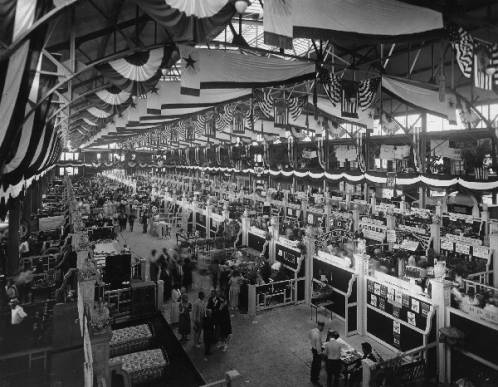
The handful of people in the foreground offers a sense of scale.
This was the Merchants and Manufacturing Building, which had opened eight years before with the claim it was bigger than Madison Square Garden. Built at the old Kentucky State fairgrounds, the cavernous room was filled with company kiosks, including “Southern Star” and “Auto Insurance.”
The old fairgrounds were in the neighborhood now known as Chickasaw. In 1907, 150 acres were purchased at the end of Cecil Avenue, west of 38th Street and north of Gibson Lane, and the fair was held there a year later, according to the University of Louisville Photographic Archives, the source of this photo.
The Kentucky State Fair is one of the oldest in the United States, according to the Filson Historical Society, dating to 1816, when Colonel Lewis Sanders of Fayette County organized the first one in the commonwealth. It became official in 1902 after being mandated by the Kentucky General Assembly.
In 1956 the fair was moved to the Kentucky State Fairgrounds and Exposition Center where it remains today. This year’s opened today and runs through Aug. 28. Admission, hours and more information here.
1936: Brown-Forman advertising car, possibly in front of the company’s distillery on Dixie Highway south of downtown. The promotion included the company’s founding bourbon, Old Forester; plus two brands no longer produced: Bottoms Up Whisky, and Old Polk, according to the University of Louisville Photographic Archives.
Yesterday, the founding Brown family rotated three new family members onto the board of directors of the nearly 150-year-old Louisville spirits giant.
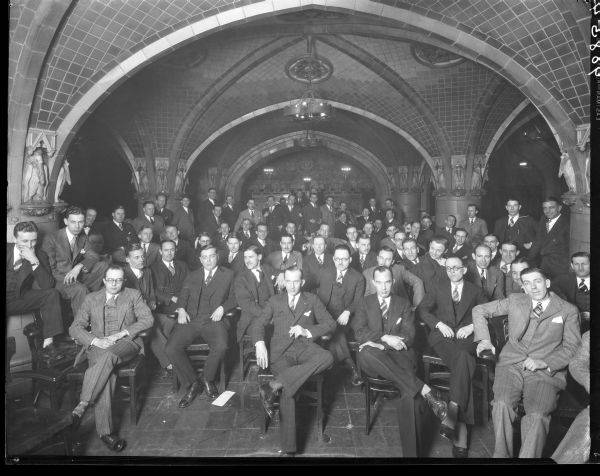
Mobster Al Capone reportedly hung out in the Rathskeller.Members of the American Business Club met in the Seelbach Hotel’s Rathskeller in March 1928, in this photo from the University of Louisville Photographic Archives. Pelican sculptures created by Rookwood Pottery of Cincinnati embellish the columns in what was a booming night club in the 1920s and 1930s.
Rathskeller (“council’s cellar” in German) is a name in German-speaking countries for a bar or restaurant in the basement of a city hall. At the Seelbach, the name reflected the background of the hotel’s Bavarian-born founders, brothers Louis and Otto Seelbach. They opened the hotel in 1905 as Louisville’s answer to the old-world grandeur of European hotels in Vienna and Paris.
Louis arrived in 1869 at 17 years old, and his brother followed in 1891, during a wave of German immigration that transformed Louisville’s economy. Already by 1850, Germans accounted for nearly 20% of the city’s 43,000 residents.
The world was a very different place on Jan. 17, 1942 — the day Cassius Marcellus Clay Jr. was born on Grand Avenue in Louisville’s West End. Employers were free to discriminate on the basis of sex and race, as these help-wanted ads make clear from that day’s Courier-Journal.
The first ad, for junior stenographers at Louisville City Hospital, was aimed at both white and “Negro” women — and at a good salary, too: $71.50 (a month, no doubt). Adjusted for inflation, that would be equivalent to $1,050 in 2016 dollars, according to the Bureau of Labor Statistics.
In 1942, Odessa Grady Clay was herself a 25-year-old household domestic, who might have sought work in one of these jobs-offered ads. Many years later, of course, she became famous, as the mother of one of the 20th century’s most celebrated sports figures: Muhammad Ali.
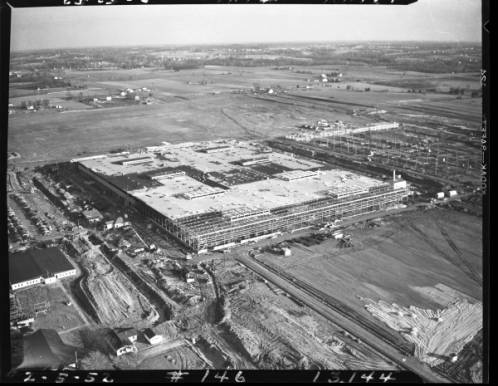
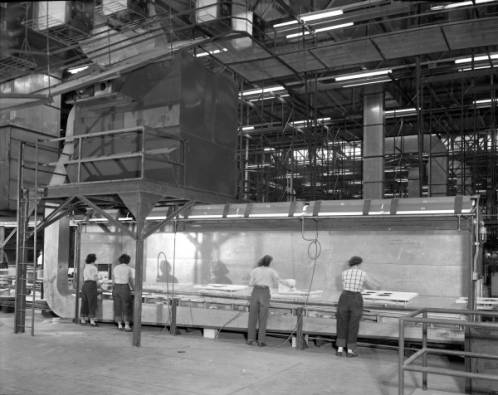
China’s Haier Co. may close on its $5.4 billion purchase of the iconic 65-year-old Appliance Park as soon as Monday. Built during the rapidly growing post-World War II economy, the 1,000-acre park churned out dishwashers and other home appliances for the burgeoning baby boom generation. Construction started in 1951.
With Ford and other big local manufacturers, GE launched a solid middle class that became the foundation of Louisville’s economy. At one time, the park employed 25,000 workers. It was a self-sufficient city providing many of its own needs, right down to mail handling. (In 1953, it got its own Zip Code: 40225.)
But that started to ebb in the 1970s, as manufacturers sought cheaper labor by moving production overseas. Appliance Park now employs only 6,000 workers. Service jobs have become the fastest-growing part of Louisville’s economy. But they’re often part-time and don’t pay as well as factory work once did.
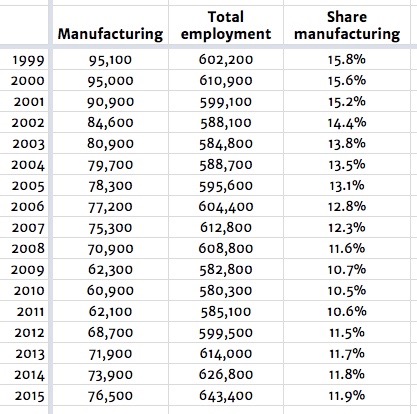
Manufacturing employment last peaked in the Louisville metro area in 1999, when there were an average 95,000 jobs, according to the Bureau of Labor Statistics. It then fell to a low of 60,900 in 2010, when the economy was still recovering from the Great Recession. The better news is that it’s crept up every year since, to 76,500 last year. But it’s extremely unlikely it will ever return to the glory days of 1951, when Appliance Park was king.
News about business and culture in Louisville, Ky.

 The Kentucky State Fair is one of the oldest in the United States,
 Rathskeller (“council’s cellar” in German) is a name in German-speaking countries for a bar or restaurant in the basement of a city hall. At the Seelbach, the name reflected the background of the hotel’s Bavarian-born founders, brothers Louis and Otto Seelbach.

 Boulevard