Tag: SEC documents

$125M Appliance Park value far more than GE once claimed; Humana employees fear threat, and California UPS driver rescues world’s cutest puppy

A news summary, focused on 10 big employers; updated 7:33 p.m.
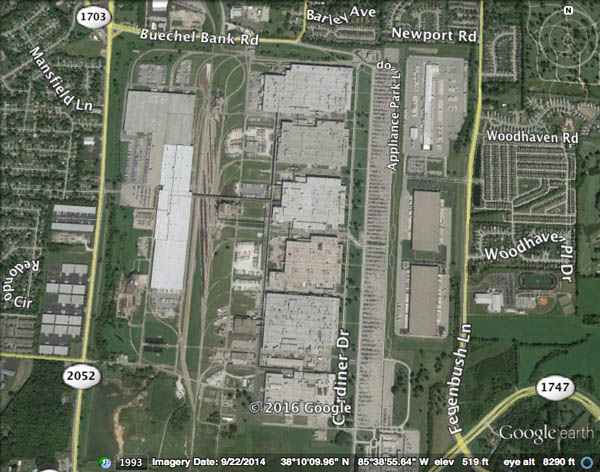
Appliance Park aerial
An aerial view shows Appliance Park.

GE sold Appliance Park to Haier Group for five times what it claimed the complex was worth in 2013, when it won a dispute with Jefferson County over the southend property’s value, a dispute that ultimately reduced the taxes the conglomerate paid. At the time, GE said the complex was worth $23 million, nearly half the $42 million value assigned by Property Valuation Administrator Tony Landauer’s office (WDRB).

HUMANA beefed up security yesterday after reports of what some employees said was a threatening graffiti message written on a bathroom wall at the insurer’s Waterside building downtown, one the company seriously enough to allow employees to go home early. The FBI is investigating the incident, said WAVE. The threat may be related to annual gay pride events planned downtown this weekend. Several employees told WLKY the graffiti referenced last weekend’s mass shooting at an Orlando gay bar, where a suspected terrorist possibly inspired by ISIS killed 50 people and injured another 50 (WAVEWLKY and Courier-Journal).

Yesterday’s incident came after authorities arrested a Jeffersonville man arrested in California who was heavily armed and headed to a gay pride event, plus reports of possible copycat threats at a New York gay bar and in the U.K. June is gay pride month in many cities, with parades and other public festivities (Courier-Journal, Time and BBC).

BROWN-FORMAN filed its annual 10-K report with the Securities and Exchange Commission this morning; as always, a key section describes the business itself. The filing came a day after the whiskey giant disclosed how much it paid CEO Paul Varga and other top executives, plus fresh details about the value of the controlling Brown family’s $6 billion in stock holdings (SEC document).

Triple Treat Box
It costs $19.99.

PIZZA HUT‘S bacon-stuffed pizza has arrived in the U.K., but only for in-the-know customers. “To savour one of the new pimped-up crusts, all you need to do is whisper the secret words ‘Bacon Crust Have’ when ordering any large pizza (Mirror). Also, the chain has brought back its Triple Treat Box in a special summer edition, “a tri-level wonder decorated to look just like your favorite picnic basket” (Delish). It includes two medium one-topping pizzas, bread sticks and the just-introduced Ultimate Hershey’s Chocolate Chip Cookie (Brand Eating).

PAPA JOHN’S: In San Diego, no injuries were reported after an SUV crashed into a Papa John’s Pizza restaurant yesterday afternoon (KGTV).

TEXAS ROADHOUSE is looking for Baltimore area cooks “who are ready for a fun and rewarding career in the restaurant business.” Applicants are considered without regard to race, religion, color, age, gender, disability, veteran status, sexual orientation, citizenship, national origin, or any other legally protected status (Craigslist). Apparently, gender expression hasn’t made that list — yet.

Puppy
Adopt me, please!

UPS: In northern California, a UPS driver who happened to be on the scene rescued a crazy-cute puppy dumped Tuesday evening in the street by a passing vehicle. The Modesto Bee identified the driver as 39-year-old Jason Harcrow of Hughson. Police said the puppy, believed to be a Cairn terrier less than a year old, was in great spirits and would be put up for adoption at the county shelter (KPIX). The driver who abandoned the pup is expected to spend eternity in hell with tobacco lobbyists.

In other news, U.S. stocks closed slightly higher, with the Dow Jones Industrial Average and other indices up less than 1% (Google Finance). Among Boulevard’s 10 big Louisville employers, Papa John’s performed best, closing at $65.89, up 2%. And on the A-list front, there was no news of any consequence about Louisville native and Oscar winner Jennifer Lawrence.

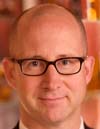
B-F paid CEO Varga $9.6M, just-filed proxy report says; it also reveals fresh details about Brown family stockholdings

Paul Varga
Varga

Brown-Forman chief executive Paul Varga‘s fiscal 2016 pay was down from $11 million the year before and $12.3 million two years prior, the company disclosed in its annual shareholders proxy report.

Compensation for the other four highest-paid executives was mixed vs. the year before, according to the report, which the Louisville whiskey distilling giant filed with the Securities and Exchange Commission late this afternoon.

The figures appear on Page 40, and cover the year ended April 30. In addition to Varga, they include CFO Jane Morreau; Mark McCallum, president of the marquee Jack Daniel’s brand; Jill Jones, executive vice president over North America and Latin America regions, and General Counsel Matthew Hamel.

Garvin Brown IV
Brown

Chairman George Garvin Brown IV got paid non-equity incentive compensation of $531,787 plus a small salary of $38,750. (“Non-equity incentive compensation” sounds like a cash bonus, but for some reason, Brown-Forman doesn’t use that term.)

In fiscal 2015, Brown’s non-equity incentive pay was much less: $281,845, according to last year’s proxy report. But that year he was still working as an executive vice president in addition to his chairman’s duties. For his EVP work, he was paid $320,427. He left that job a year ago today.

The company also said it incurred $18,359 for certain expenses associated with Brown’s living abroad, and other employee benefits provided to him. The proxy report doesn’t say where Brown, 47, was living at the time. (London, it appears, based on this Globe and Mail story last year.)

The Browns are firmly in charge

The Brown family controls Brown-Forman through their enormous stock portfolio, preserved through multiple generations — at least four — that followed George Garvin Brown, a pharmaceuticals salesman who started the company in Louisville in 1870. At current market prices, the family’s holdings are worth at least $6 billion — but in reality, much more.

The holdings are divided between the company’s two classes of stock: “A” shares, which carry voting rights, and non-voting “B” shares. Both classes trade on public markets, although for different prices. The family owns at least 67% of the A shares, according to the proxy report.

Campbell Brown, Old Forester
Campbell Brown

Chairman Brown and his brother, Campbell Brown — who’s also a senior executive at the company — hold one of the family’s single-biggest stakes: 6.8 million class A shares, through an entity called the G. Garvin Brown III Family Group. At today’s closing price of $105.48, those shares are worth $718 million.

Campbell, 48, has been president and managing director of Old Forester, the company’s founding bourbon brand, since 2015.

Keeping business in the family

Another big stockholder is Laura Lee Brown, who with her husband Steve Wilson, founded the trendy 21c Museum Hotel chain in Louisville. She owns 2.2 million class A shares outright, worth $233 million at current prices.

Steve Wilson Laura Lee Brown
Wilson and Brown.

In the proxy report, Brown-Forman said it did business with the couple, as it has in previous years. It includes developing historic Whiskey Row on Main Street into a complex of new lofts, retail and restaurant space to be called 111 Whiskey Row. The company paid $900,000 to a company controlled by the couple: Brown Wilson Development, according to the proxy report.

The project was heavily damaged in a fire last summer, but was saved and work continues.

Brown-Forman also paid the couple $267,395 for rooms, meals and other entertainment at their 21c hotel and its Proof on Main restaurant. It also paid them another $250,440 for leases on parking spaces in a garage they own adjoining Brown-Forman’s downtown offices.

Unraveling founding family’s wealth

Valuing the Brown family’s total stock holdings is difficult. Individual members own shares outright. They also have partial, beneficial ownership through family partnerships and legal entities. Because they overlap with other family members, it’s hard to assign a value to them.

However, counting each share just once among family members owning more than 5% of all outstanding shares, their combined total is about 57 million, worth $6 billion. But that only covers shares held by the single-biggest owners who, under Securities and Exchange Commission rules, are required to disclose holdings exceeding 5%. There may be other Browns sitting on multimillion-dollar positions, undisclosed because they don’t meet the 5% threshold.

And that’s only counting the class A shares. The Browns own several million non-voting B shares, too. Determining exactly how many is tricky, but tables and footnotes in the proxy report offer clues.

For example, Garvin Brown IV and his brother Campbell together own 1.3 million Class B shares outright; at today’s closing price of $97.90, they’re worth another $125 million. Adding that to their A shares, the brothers own $843 million in stock.

Sandra Frazier
Sandra Frazier

Sandra Frazier, who just cycled off the board of directors, owns 373,376 B shares plus 1.4 million A shares. They’re worth a total $185 million. Frazier, 44, is CEO of Tandem Public Relations in Louisville, which she founded in 2005. She’s also a member of the board of directors at Glenview Trust Co., a boutique wealth management company that serves 500 of the richest families in the area.

Laura Frazier
Laura Frazier

Her first cousin, Laura Frazier, joined the Brown-Forman board when Sandra left. Laura owns 239,829 B shares and 225,433 A shares. Combined, they’re worth $47.3 million. In addition to being a director, Laura, 58, owns Bittners, the high end furniture and decorating company in NuLu.

Oh, boy! We invite you to read this 13,000-word document Kindred just filed with federal stock regulators

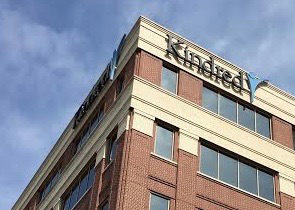
Kindred building detail
Kindred headquarters at Fourth and Broadway.

Kindred has reached a deal with lenders handing the hospital and nursing home giant more flexibility over entering into joint ventures, plus provides an additional $200 million in credit.

At least, that’s what we think today’s filing with the Securities and Exchange Commission means, because we haven’t slogged through the full 13,000-word filing; the 8-K material events notice was filed an hour ago.

From Kindred, ‘fungible’ is our word for the day, and we’ll now use it in many conversations

Kindred headquarters
Company headquarters at Fourth and Broadway.

The healthcare giant just issued the following press release:

Kindred announced today it completed syndication and pricing of an incremental $200-million term loan, the proceeds of which will be used to repay outstanding borrowings under the company’s existing $900-million senior secured asset-based revolving credit facility (the “ABL Facility”). This borrowing will have the same terms as, and will be fungible with, the outstanding $1.18 billion of term loans under Kindred’s existing senior secured term loan credit facility (the “Term Loan Facility”). The incremental term loan will be issued at 99.05% of par.

In connection with the incremental term loan, the company also received consent from the required lenders under the Term Loan Facility and the ABL Facility to amend various provisions of those credit facilities, including to allow for a broader range of joint venture activity, increase the company’s financial flexibility and make other changes to better align the terms of these borrowings with Kindred’s strategic plan.

Kindred has retained J.P. Morgan Securities to act as sole lead arranger and sole bookrunner for the incremental term loan. JPMorgan Chase Bank is the administrative agent and collateral agent for the Term Loan Facility, under which the incremental term loan will be borrowed.

Related: investor relations, where you’ll find more press releases, plus SEC documents.

Got another head-spinning word? Please post it in the comments section, below.

Texas Roadhouse is the biggest Louisville-based restaurant chain you’ve never heard of

Texas Roadhouse
Founded in 1993, the company now has nearly 500 restaurants and 48,000 employees.

Boulevard focuses on news about some of Louisville’s biggest employers, nonprofits, and cultural institutions. This is one in an occasional series about them.

Put your books away; it’s time for a pop quiz!

Ever heard of a Louisville-based restaurant chain called KFC? Of course you have. Papa John’s? Certainly.

Now, what about that other big Louisville-based chain: Texas Roadhouse. Not so much?

KFC (15,000 restaurants in more than 125 countries) and Papa John’s (4,700 stores, 37 nations) are better known in Louisville at least partly because they’re older, and promote themselves more locally. There’s the KFC Yum Center downtown, and Papa John’s Cardinal Stadium at the University of Louisville. And who hasn’t seen Papa John’s founder John Schnatter in one of his ubiquitous TV commercials?

Kent Taylor
Taylor

But Texas Roadhouse has come a long way, too — and in a relatively short time. Chairman and CEO Kent Taylor started the steakhouse chain in 1993 with a single restaurant in southern Indiana. Some 23 years later, it’s grown to nearly 500 company-owned and franchised restaurants in 49 states plus five foreign countries, and 48,000 employees.

That three big restaurant companies are all based in Louisville isn’t a huge surprise given an economic principle with an unwieldy name: agglomeration. That’s where companies beget other companies in the same industry nearby, all benefiting from the increasingly specialized labor pool and economies of scale: for example, intellectual property attorneys experienced in the fast-food trade.

Peanut shells
Western theme peanut shells.

Taylor, for one, started out as a KFC manager in 1990, when he returned to his Louisville hometown. Three years later, he opened the first Texas Roadhouse, in Clarksville, Ind. The restaurants are known for their western themes, line-dancing servers, peanut shell-strewn floors, and Texas Red Chili and ribs.

The company went public in 2004. Its headquarters is at 6040 Dutchman’s Lane.

Now 60, Taylor is the biggest individual stockholder, with 4.4 million shares, or 6.2% of all, according to the 2016 shareholders’ proxy report. His stake was worth more than $200 million in June 2016, when shares were trading at a record high of $46 each.

Tantalum?! Amazon document is an inside peek at newest compliance woes for top brass

Amazon has just filed its annual “conflict” minerals report with the Securities and Exchange Commission on a detailed — and we mean detailed — survey of suppliers who might unwittingly work with armed groups committing war crimes in the Congo region.

Gold
Yes, it’s gold.

The scores of companies supply commodities for making Amazon’s Kindle e-readers and Fire tablets. Last year’s survey literally ran from A (Aida Chemical Industries Co. in Japan) to Z (Zijin Mining Group Co. Ltd. Gold Refinery in China) in nearly 60 countries on all seven continents. The minerals are gold, tin, tungsten, and tantalum. The bottom line:

“While, for 2015, we identified no suppliers that were sourcing minerals through a supply chain that benefitted armed groups in the Democratic Republic of the Congo region, some of the suppliers for our Kindle/Fire products are still working to determine country of origin and facility information, and other suppliers are still investigating whether the facilities they identified were used to process the gold, tin, tungsten, or tantalum in our Kindle/Fire products.”

Related: SEC conflict reports explainer.