A news summary focused on 10 big employers; updated 4:37 p.m.
UPS: This morning in Lexington, Ky., a Fayette Circuit judge denied a motion to overturn a jury’s April verdict and $5.3 million in damages to eight black men who claimed a hostile work environment at a UPS facility in the city. Judge Ernesto Scorscone also rejected UPS attorney Neal Shah’s motion for a new trial. Shah didn’t have any comment after the hearing (Herald-Leader).
HUMANA and Aetna have only a slight chance to reverse the Justice Department’s decision yesterday to block their $37 billion merger, analysts and investors told Reuters, even as the two insurance giants promise to fight tooth and nail to win. “My initial impression from the complaint . . . is that the Justice Department and the states are on much safer ground” in their argument against an Aetna-Humana, said Beau Buffier, co-head of the antitrust group at Shearman & Sterling in New York (Reuters). Meanwhile, New Hampshire and Florida — with an especially big population of seniors — joined the Justice Department suit filed yesterday to block its $37 billion acquisition by Aetna of Hartford; Illinois joined the suit yesterday (Union Leader and News 4 Jax).
 In more encouraging news, Humana was awarded a six-year Defense Department contract for the East Region of TRICARE, the military health care program providing benefits to service members, retirees and their families. Under the award, Humana’s service area would expand to about six million beneficiaries in a 30-state region. The Louisville-based insurer already has the contract for the South Region: Alabama, Arkansas, Florida, Georgia, Louisiana, Mississippi, Oklahoma, South Carolina, Tennessee, most of Texas and the Ft. Campbell-area in Kentucky. The new East Region is a combination of the current South and North regions (press release). The contract is worth $41 million (Federal News Radio). Humana’s announcement, nearly buried in yesterday’s DOJ news, to exit eight of 19 state health-care exchanges drew critics, who saw the move as a direct challenge to the Obama administration to block the Humana-Aetna merger (New York Post).
BROWN-FORMAN was awarded a score of 100 in the 2016 Disability Equality Index survey, by the US Business Leadership Network and the American Association of People with Disabilities. The survey awarded points in four major categories: culture and leadership, company-wide access, employment practices, and community engagement and support services. This year, 83 Fortune 1000-size companies completed the survey; two-thirds of these top the Fortune 500 list; complete list (news release).
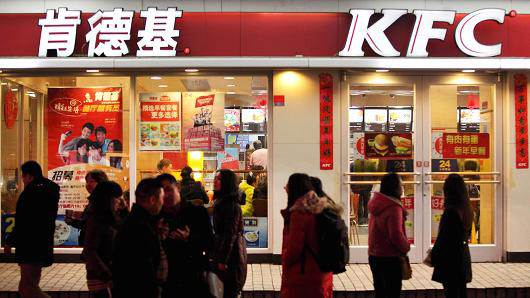
KFC: Chinese nationalists have added iPhones and Continue reading “Lexington judge won’t budge on $5.3M bias award against UPS; Humana’s got slim chance beating anti-trusters; BF nabs top disability award; and Chinese nationalists expand protests beyond KFC” →

 On July 21, the DOJ filed a civil antitrust complaint (which we refer to as the DOJ action) against us and Aetna in the U.S. District Court for the District of Columbia, charging that the merger would violate Section 7 of the Clayton Antitrust Act and seeking a permanent injunction that would prevent the Merger. The filing of the DOJ action is delaying, and, if we and Aetna are unsuccessful in defending against or settling the DOJ action, could ultimately prevent, the consummation of the merger. There can be no assurance that we will be successful in defending against or settling the DOJ action or that the merger will be consummated by any particular time, if at all.

 Boulevard