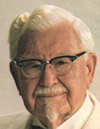
It’s the original recipe Colonel Harland Sanders developed in 1939 for his roadside restaurant in Corbin, Ky., the one with 11 herbs and spices that launched today’s 20,000-location KFC. The Chicago Tribune has published what it says is the top-secret recipe, which a freelance writer got during a visit with Sanders’ nephew, Joe Ledington, a 67-year-old retired school teacher outside Corbin.
Sanders
Ledington told writer Jay Jones he’d found the recipe, handwritten in blue ink, tucked inside a photo album he inherited from his aunt, Sanders’ second wife. The newspaper included a photo of it with a story today about the Harland Sanders Cafe and Museum in Corbin.
But as even the daily points out, many others have claimed to have seen what KFC calls one of America’s most valuable trade secrets. “But no one’s ever been right,” the company told the Tribune.
For the past two years, developers of the West Louisville FoodPort worked mightily to bring urban farming and as many as 250 good jobs to the heart of a neighborhood yearning for a better future. Mayor Greg Fischer said the project would “change the look and feel of Russell forever.” Their ambitious, $35 million plan was going so well, one of the world’s foremost advocates of organic food paid a headline-grabbing visit last year: Prince Charles, heir to the British throne.
Reily
But yesterday, the entire enterprise collapsed when the non-profit developers, Seed Capital Kentucky, abruptly announced they’d lost a linchpin partner, and without enough time to find a replacement. “We don’t have a way to put it together,” Seed Capital co-founder Stephen Reily said. “We are deeply disappointed.”
Many, many other people were disappointed as well: the mayor, who’d pushed the project as a centerpiece for revitalizing the Russell neighborhood, only to see it steadily scaled back amid community infighting; some 150 residents who helped shepherd the project past months of political hurdles, and the Russell councilwoman, Cheri Bryant Hamilton, “heartbroken” last night over its failure, The Courier-Journal said.
But less publicized was the distress almost certainly felt by a high-profile Louisville family who had invested heavily in its development: the Browns, founders of the spirits giant Brown-Forman. It was an unusual defeat for a family that’s often in the vanguard of high-profile causes ending in resounding success.
Brown
The Browns were there at critical junctures for the FoodPort, including last year’s goodwill tour by Prince Charles and his wife Camilla, the Duchess of Cornwall. In a speech at the Cathedral of the Assumption on that overcast Friday in March, the CJ reported at the time, “the prince credited his visit to the persuasive powers of Louisville philanthropist Christina Lee Brown, matriarch of the family that controls Brown-Forman.”
Indeed, in 0ne photo with the newspaper’s online story, the unidentified woman in an orange coat and strands of pearls, beaming in the royal couple’s wake during one of their walkabouts, is Christina, known to many in Louisville as Christy.
Holland
As one of the city’s best-known philanthropists, she and her immediate family have formed the core of the extended Brown family’s support of Seed Capital. Her daughter, Augusta Brown Holland, an urban planner and investor, is one of the non-profit’s six board members. Another daughter, Brooke Brown Barzun, has a more direct line to Buckingham Palace: Her husband, Matthew Barzun, is U.S. Ambassador to the United Kingdom.
A tale of IRS tax returns
The Browns donate multimillions of dollars annually to charities from coast to coast, although especially in Louisville. But they don’t often seek attention for their contributions.
On the CJ: Camilla, Christy and Charles.
In fact, Seed Capital only hints at the family’s hefty financial support,
on a difficult-to-find page of its website with a barebones alphabetical roster of “funders.” Of the 16 names listed, six are Brown family members or their personal charitable foundations. A seventh is the source of their $6 billion fortune: Brown-Forman, the nearly 150-year-old producer of Jack Daniel’s and other well-known brands. And an eighth, the Community Foundation of Louisville, is home to at least 10 individual Brown donor-advised funds.
Those glittering headpieces are for everybody nowadays, according to a story in one of our favorite business bibles: The Wall Street Journal. And Louisville, it turns out, has a primo place to buy them, with literally hundreds to choose from.
Kate’s hand-me-down.
Now, we’re not talking about the real diamond deals — like the heirloom tiara Kate Middleton wore for her 2011 wedding to Prince William. Made by Cartier for Queen Elizabeth’s mother in 1936, it’s paved with 739 brilliant-cut and 149 baguette-cut diamonds.
Wall Street Journal writer Dana Thomas wasn’t made of money, either, when she stumbled on the tiara trend while planning her 1960s-themed 50th birthday party. “My husband and I hired a swinging jazz combo and urged invitees to dress in Rat-Pack chic,” she wrote. “And I made an appointment with my hairdresser David Mallett in Paris, where I live, to acquire a big updo.”
Thomas planned to add a toy tiara from her daughter’s dress-up days. “Little did I realize I was participating in a legitimate fashion trend,” she says, pointing to a flurry of tiaras seen at spring fashion shows and social galas. Indeed, if Thomas had been in Louisville in January, she would have seen the 2016 Derby Festival Royal Court introduction: five tiara-topped women eager to be crowned the annual Festival Queen. (And the winner was…)
Boulevard readers will be delighted to know they needn’t travel all the way to the Parisian arrondissements where Thomas shopped. Here in the city named for France’s Louis XVI, we have Affordable Elegance Bridal, a 10-year-old online emporium offering more than 300 tiaras, plus the occasional crown.
It’s a bargain!
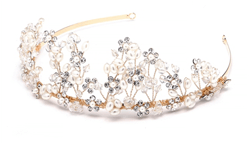
The least expensive — the Botanical Pearl and Crystal Wedding Tiara — sounds very fancy indeed, for only $45 (marked down from $72): “Mariell’s soft cream pearl and crystal statement tiara will glam up your wedding with intricate hand-wired floral sprays. For a stunning blend of en vogue design and classic bridal couture, this headpiece is bursting with botanical femininity.”
Tiara prices max out at $249 for the silver-plated Artemis, adorned with hundreds of rhinestones.
In addition to web shopping there, customers can order by phone Monday through Saturday, 9 a.m. to 6 p.m. (Eastern Time). 502-835-4421. Shipping is free within the U.S.
Photo, top: Raven (left) and Manila Luzon (right) crown Chad Michaels, winner of RuPaul’s Drag Race All Stars 2012.
Irish celebrity news website Entertainment.ie is the latest to ask that meme-ready question, today, and immediately answered it: “No, you haven’t, because they’re the same person.” Which, of course, is baloney, although even Mirren has noticed the similarity between her much younger self and Lawrence, who turned 26 only yesterday.
In the photo mashup, above, that’s Mirren on the left, when she was in her late 20s or early 30s.
Comedian Jon Stewart first raised the likness in 2013, when he showed Lawrence a 1970s-era photo of the British actress. Watch the video of the Oscar-winning Louisville native and gorgeous, 71-year-old Mirren:
A year ago, the Louisville-based insurance giant had already signed up 90% of its 50,000 employees to an internal social network, and 40-45% logged in at least once a month. That’s when it decided to encourage the most motivated ones to share approved articles about the company, plus other health-care news on Twitter, Facebook, LinkedIn and other networks outside the company, AdAge reports today.
Employees use the hashtag #HumEmployee to make clear they work for the company. To launch the program, called Humana Advocates, the insurer hired Dynamic Signal, a Silicon Valley company that builds employee advocacy systems. The pilot program started with a couple hundred staffers, rising to 500 by January. Since then, the number has jumped to 3,000.
Gingiss
The system shows a list of approved articles for users to share. But most of it “isn’t directly Humana-related, because we don’t want employees to look like shills for the company,” Dan Gingiss, Humana’s head of digital marketing, told AdAge. Most of the content is about health and wellness, some of which is created by Humana itself, with the rest from third parties.
Humana’s effort is only the latest example of how companies are fiercely competing for market share by harnessing free social media technology, where hundreds of millions of current and potential consumers spend more and more time. Twitter says some 313 million people use the short-message platform each month. The figures on Facebook are even higher: 1.7 billion, including 1.1 billion every day.
Among Louisville companies, the battle is especially strong among restaurant giants that compete for young customers who practically live online: Yum’s troika of KFC, Pizza Hut, and Taco Bell; pizza colossus Papa John’s, and steakhouse chain Texas Roadhouse. On the public-relations front, companies also need all the help they can get from employees to burnish their image when bad news spreads online.
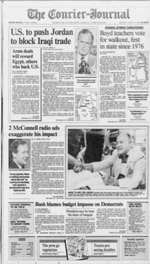
On Aug. 15, 1990, The Courier-Journal delivered a 52-page paper chock-a-block with news. President George H.W. Bush was rounding up support for an embargo against Iraq, retaliating for its invasion of Kuwait less than two weeks before. Sen. Mitch McConnell, still in his first term, was on the hot seat in his re-election campaign. Kentucky’s powerful tobacco industry still didn’t accept the dangers of smoking. And comedian Bob Hope and his pet poodle were in town. It was a humid Wednesday, with temperatures heading for 86 degrees. The news:
“U.S. Sen. Mitch McConnell’s re-election campaign is extolling his 5½-year record with a wide range of radio commercials — at least two of which exaggerate the impact of his work,” CJ political writer Al Cross wrote in a page-one story. “Those two ads say McConnell worked out the financial problems of Big Rivers Electric Corp., and saved the Kentucky construction industry by casting the deciding vote against a presidential veto of a highway bill.”
The record, including statements from company and government officials, contradicted McConnell’s account, Cross said. But the Louisville Republican vigorously defended the commercials, saying they weren’t inaccurate or misleading. At the time, McConnell faced Democratic nominee Harvey Sloane, the former Louisville mayor and county judge-executive.
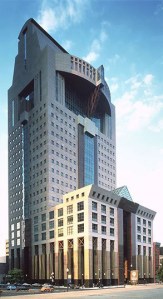
Humana Tower
Humana nixes smoking
Citing concerns about deaths linked to passive smoking, Humana said it would ban smoking at its corporate headquarters downtown and in all division offices starting Feb. 1, 1991. The health insurance giant’s decision came after a June report by the U.S. Environmental Protection Agency that about 3,800 lung-cancer related deaths per year among non-smokers are caused by secondhand cigarette smoke. Humana estimated only 1 in 7 employeees smoked, a decrease of about 35% from several years before.
The story noted that “the tobacco industry, which has never agreed that smoking is a hazard even to smokers themselves, has attacked the EPA findings as unsubstantiated.”
Comedian Bob Hope signed copies of his new book, “Don’t Shoot, It’s Only Me,” at the W.K. Stewart Booksellers in the Holiday Manor Shopping Center. The 87-year-old stayed at the Galt House with his wife Dolores and their poodle Baxter.
That day’s CJ carried three full-page ads for Louisville-based Bacon’s Department Store, and four full pages of business news, including 2½ pages of stock listings. The Dow Jones Industrial Average had closed the day before at nearly 2,748 points.
ValuMarket was selling half-gallon cartons of Sealtest ice cream for $1.98. TWA offered roundtrip tickets to New York City for $158.
And unknown to most everyone reading that day’s paper, Jennifer Shrader Lawrence was born to Gary Lawrence, a construction worker, and his wife Karen, a children’s camp manager.









 Among Louisville companies, the battle is especially strong among restaurant giants that compete for young customers who practically live online: Yum’s troika of KFC, Pizza Hut, and Taco Bell; pizza colossus Papa John’s, and steakhouse chain Texas Roadhouse. On the public-relations front, companies also need all the help they can get from employees to burnish their image when bad news spreads online.
 That day’s CJ carried three full-page ads for Louisville-based Bacon’s Department Store, and four full pages of business news, including 2½ pages of stock listings. The Dow Jones Industrial Average had closed the day before at nearly 2,748 points.
 Boulevard