Newspapers are suffering an accelerating drop in print advertising, a market that already was under stress, forcing some publishers to consider significant cost cuts and dramatic changes to their print and digital products, according to a new Wall Street Journal story with implications for The Courier-Journal and the broader Louisville media scene.
Today’s Page One.
Jefferies stock analyst John Janedis has forecast an even more difficult calendar third quarter. Last month he lowered his estimates for Gannett Co., forecasting a 12.5% drop in combined print and digital ad revenues.
We’ll see how accurate he is when Gannett reports third-quarter results next Thursday morning.
Wall Street is worried. Gannett’s stock traded at a new 52-week low this morning, $10.16, before easing back into the black.
The figures will come after a recent management shake-up at the CJ, where top editor Neil Budde quit unexpectedly last week. Published reports said management believed too much emphasis had been placed on digital vs. the print version. That’s hard to fathom, however, when newspapers face more and more competition from online upstarts such as Insider Louisville.
Neil Budde‘s abrupt resignation was announced this morning in an email to staff from Publisher Wesley Jackson, who didn’t provide an explanation for his departure. Budde, who is about 60, had been in the job since September 2013.
Budde
Budde leaves as the paper faces heightened competition from legacy rivals such as WDRB and from new ones: WFPL’s Kentucky Center for Investigative Reporting, and digital standalone Insider Louisville.
In his email, Jackson said: “We will sharpen our focus on investigative journalism and the urgency of all our coverage while doubling down on our goals of building new audiences and engaging them digitally.”
Jackson didn’t say whether any other staffing changes were in the works.
CJ owner Gannett Co. is ramping up efforts to coordinate news coverage among the approximately 100 dailies in the chain by having reporters from different sites work together on projects with a more national scope. The Louisville paper’s shakeup also comes as Gannett draws closer to buying Tronc, which owns the Los Angeles Times, Chicago Tribune and seven other big dailies plus 160 smaller weekly and monthly niche titles.
Jeff Taylor, the top editor at the CJ’s sister paper, the Indianapolis Star, will serve as interim editor while a permanent editor is found, according to Jackson.
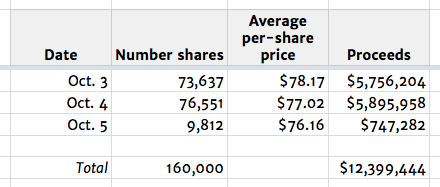
PAPA JOHN‘s CEO John Schnatter continued unloading shares in the pizza giant, selling another 86,000 on Wednesday and Tuesday for $6.6 million, according to a Securities and Exchange Commission filing. That trade followed Monday’s, where the executive sold 73,637, and are in accordance with a trading plan he adopted early last month.
In other news, the economy added 156,000 jobs last month vs. a forecast 170,000, the Labor Department said. The jobless rate, meanwhile, rose to 5% from 4.9% in August, according to the agency (multiple news accounts).
Courier-Journal owner Gannett Co.’s bid to acquire Tronc, owner of the Chicago Tribune, Los Angeles Times and other papers, could wrap up in the next two weeks if all the due diligence now underway checks out, sources tell the New York Post. “There is no disagreement on price, but there is still some [work] to be done,” one source close to the situation told the New York tabloid (Post).
The Post report follows an earlier one at Politico, which speculated the deal could be announced as early as this week.
As The Courier-Journal’s owner advances on a takeover of the Los Angeles Times and more than 160 other titles, it has promised it won’t take a top-down approach to managing news at the company’s existing chain of more than 100 papers.
Davis
A big test of that pledge comes with one of Gannett Co.’s newest editors, Chris Davis, hired for a new position leading the company’s chain-wide investigative reporting. He joined the company in July from the Tampa Bay Times, where he edited two Pulitzer Prize-winning projects.
In a new interview, Davis talked to industry trade site Columbia Journalism Review about what he sees in the future for the CJ and Gannett’s other dailies. Here’s an excerpt:
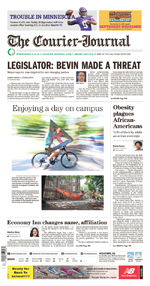
Today’s paper.
What do you think this new position says about Gannett’s journalistic ambitions now and in the future, especially as the company continues to refine its strategy?
To me, it’s a clear signal that the editors here are putting journalism first, particularly investigative journalism. They could have hired all sorts of people, but they wanted someone who could come in and really drive the most important kind of journalism, which is watchdog and investigative work. I think it shows a clear commitment, and it was one of the reasons I was intrigued at the outset. They want someone who is exclusively focused on investigative work to be in a top-level position. I think that says a lot.
In business journalism, some of the most interesting news shows up in fine-print footnotes in documents companies file with government agencies. Hospital and nursing giant Kindred Healthcare is great example. Last spring in a statement to stockholders, it disclosed two special payments to top executives: $6 million to then-executive vice chairman Paul Diaz in connection with his leaving the CEO’s job, and $250,000 to Chief Financial Officer Steven Farber, to help him escape a high-profile dispute with a Glenview neighbor. But to uncover that, you had to follow three different footnotes on a table showing how much they got paid overall.
This leads me to another footnote, of sorts — one that appeared on a story today at Insider Louisville, the online news site launched in 2010, and to a document I’ve run across at the Securities and Exchange Commission. Together, they open a window on who’s investing in Louisville’s news media at a time when the once-dominant Courier-Journal has been losing influence amid steep staff cutbacks, shifting the balance of power in Kentucky’s biggest city. They underscore the importance of news outlets everywhere telling readers who’s behind the scenes, and about any conflicts of interest owners may pose for their publication. (I’ve got disclosures of my own.)
This morning, at the bottom of a long story about the Humana Foundation, Insider Louisville editors added this disclosure: “One of the five directors of the Humana Foundation is David A. Jones Jr., an investor of Insider Louisville.”
Jones
Jones is one of Louisville’s more influential residents. He’s on the board of directors of Humana itself, and his father, David A. Jones Sr., is a co-founder of the insurance giant. Jones Jr. is a partner at Chrysalis Ventures, the Louisville venture-capital firm he founded in 1993, and he’s chairman of the elected seven-person board overseeing the Jefferson County Public Schools. (Here’s Chrysalis’s portfolio of company investments; it doesn’t show Insider Louisville, which suggests this was a personal investment.)
Cottingham
To be sure, close readers of Insider Louisville have known Jones was an investor for several years. In August 2014, owner Tom Cottingham told readers he’d brought in three new minority investors he knew from a prior venture: Jones; Doug Cobb, the former Greater Louisville Inc. CEO, and Jon Pyles, now the site’s vice president of marketing. The story — which carried only a “staff” byline — didn’t say how much they’d invested, nor the exact size of their stake. Cottingham said he remained the majority holder.
Cobb
Now, though, an SEC document filed in April offers more clues about the publication’s investors, whom we learned this summer include a prominent heiress to the glittering Brown-Forman whiskey fortune. I can’t find any mention of the regulatory filing on Insider Louisville’s website, nor in any other media outlet in Louisville. My readers may well correct me after I publish this post; in any case, this is certainly the first time I’m writing about it.
The April 12 document shows that Insider Louisville LLC raised $975,000 from 12 investors in a $1.5 million stock offering that drew the first investment March 31. It didn’t identify the investors by name, however, and it didn’t say how big their stakes were. The first $450,000 was to pay down an undisclosed amount of debt, according to the document; anything left over would go to any of its directors: Jones, Cottingham, and a third named Jamie Wilson. (Who’s Wilson? I haven’t figured that out; maybe one of my readers knows.)
Named after Nancy Reagan’s anti-drug campaign, the “just say no” defense has had varying degrees of success, according to Steven Davidoff Solomon, a professor of law at the University of California, Berkeley. “Yahoo used it to fight off a $44.6 billion bid from Microsoft eight years ago,” he writes in The New York Times. “Though some dispute how serious Microsoft was at the end, Yahoo’s initial rebuff looks like a clear mistake in retrospect, as its core business recently sold for $4.8 billion.”
The risk in this strategy is that The Courier-Journal’s owner, Gannett Co., walks away instead of acquiring Tronc, leaving its rival newspaper publisher to wither like Yahoo or find its own path to success, Solomon says. And if you accept Gannett’s argument, that would effectively leave the CJ and all its 108 other sister publications in a less competitive position in a future dominated by digital media.
This morning’s.
So far, however, Tronc appears to be winning. Gannett’s initial offer last April was $12.25 a share, or $815 million. It boosted it to $15 the next month, or $864 million. And a published report last week says Gannett raised it again, to around $18 — even as Tronc is holding out for something closer to $20.
But that report by industry watcher Ken Doctor said it appeared Tronc would ultimately agree to a deal: “It’s apparently no longer a question of whether to sell or not, but for how much.”
If it wins, Gannett would add the L.A. paper, plus the Chicago Tribune, seven other big dailies and 160 smaller weekly and monthly niche titles to its existing portfolio of 109 publications in the U.S. and U.K. It would also add 7,000 Tronc employees to the nearly 19,000 it already employs.
News about business and culture in Louisville, Ky.





 This leads me to another footnote, of sorts — one that appeared on a story today at


 The risk in this strategy is that The Courier-Journal’s owner, Gannett Co., walks away instead of acquiring Tronc, leaving its rival newspaper publisher to wither like Yahoo or find its own path to success, Solomon says. And if you accept Gannett’s argument,
 Boulevard