Our favorite shiny sheet scribe, Carla Sue Broecker of The Voice-Tribune, continues her overseas dispatches from Merry Old England, giving Boulevard another opportunity to post photos of real estate porn stately country houses we’d like to visit, too!
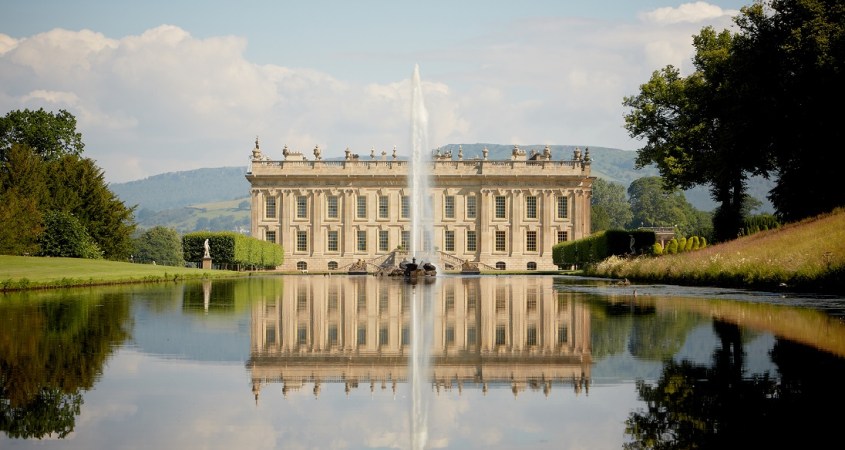
This week’s entry is Chatsworth House — “home of the Duke and Duchess of Devonshire, set in Derbyshire’s magnificent Peak District. One of Britain’s greatest historic homes offers beautiful rooms, famous works of art, a 105-acre formal garden, farmyard and enough deer to feed all of Jefferson County!”
Yikes! That’s a lot of venison. We’d need 6,200 for all the county’s residents — plus Martha Stewart’s Roasted rack of venison with red currant and cranberry sauce. (Confidential to the Duke and Duchess of Devonshire and the TSA: better check Carla’s steamer trunks on the way back home!)
“One lump, or two?”
Chatsworth (photo, top) hasn’t remained standing all these 463 years through the efforts of serfs alone. Now, it requires day visitors and brides who put the “d” in destination weddings. The house is open through Nov. 4 this year. Tickets are £23 for adults ($33.50 at current exchange rates). For £40 a ticket ($58), you’ll also get a traditional afternoon British tea. (“Homemade dainty finger sandwiches of smoked salmon and cream cheese, roasted ham and wholegrain mustard, free-range egg mayonnaise and cress and cucumber and mature cheese, plus cakes and pastries.”)
Jane Austen featured Chatsworth in her 1813 novel Pride and Prejudice, and it stood in for Fitzwilliam Darcy’s Pemberley in the 2005 film adaptation starring Keira Knightly (swoon!) and Matthew Macfadyen (double-swoon!). Let’s watch:
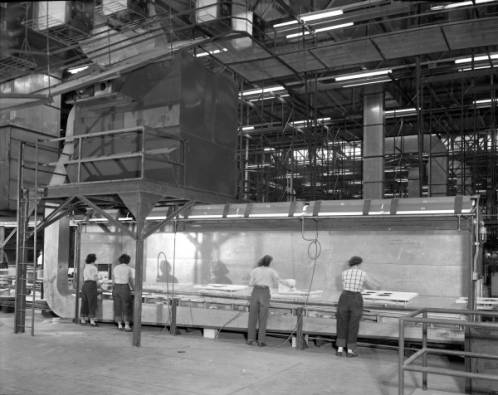
Two employees work on an Appliance Park spray line in 1953, two years after construction started. China-based Haier could close on its $5.4 billion purchase of the GE complex today.
A news summary, focused on big employers; updated 3:13 p.m.
GE: Haier has opened a new refrigerator factory in Russia to serve increasing demand from the European market. The new plant is the first joint Sino-Russian business project in a non-energy field (China.org). Back in the U.S., Haier wants its product development model to be more collaborative with its supply chain (Plastic News). The Chinese company could close on its $5.4 billion purchase of GE’s appliance business as soon as today. Meanwhile, GE is considering scrapping annual raises, as well as the longstanding and much-imitated system of rating employees on a five-point scale — moves that could lead other major companies to reconsider their own compensation plans (Bloomberg).
FORD reshuffled China sales leadership: Dave Schoch, group vice president and president of Asia Pacific, will take over and add the title of chairman and chief executive officer, Ford China. “As our growth plans in China have developed, this market is delivering an increasingly important portion of our revenue and profits globally,” CEO Mark Fields said. “Elevating the reporting of this business right now reflects China’s importance in our profitable growth plan going forward” (press release). Ford shares were up 1.2% to $13.19 40 minutes before the closing bell.
KFC will temporarily close at least some of its 12 restaurants in the southern African nation of Botswana this week after being placed under partial bankruptcy liquidation. Franchiser VPB Propco said it had been trying to the sell the restaurants for the past year without success, and the only option left was to shutter them, eliminating 400 jobs (Bloomberg). KFC clarified that the liquidation will not affect its business in neighboring South Africa (AFK Insider).
BROWN-FORMAN: Two of the newly appointed members of the board of directors — Campbell Brown and Marshall Farrer — have disclosed stock holdings in the family controlled spirits and wine company. Brown listed sole ownership of 805,313 Class A shares, and 312,208 Class B shares (SEC document). Farrer listed sole ownership of 315 Class A shares, and 116 Class B (SEC document). Both men also disclosed beneficial ownership of thousands of other A and B shares, but because some are counted twice as a result of overlapping trusts, it’s unclear how many shares are involved.
The new Fortune 500 list of the biggest-revenue companies includes three in Louisville. HUMANA (No. 52); YUM (218); and KINDRED (372). They all appeared on the magazine’s list last year, too. Walmart held onto the No. 1 spot in the rankings published today (Fortune).
TEXAS ROADHOUSE: A customer at a Dallas area restaurant regrets a missed opportunity for romance with another diner. “I was sitting outside with my two boys waiting to be seated,” he wrote in the Craigslist Missed Connections section. “You came out and we locked eyes. . . . You then asked if you knew me! You were hot, but I was honest and said no. I wouldn’t mind getting to know you tho! 😉 tell me what you looked like or what you were wearing” (Craigslist Dallas).
In other news, the late boxing heavyweight and humanitarian Muhammad Ali will be buried Friday at Cave Hill Cemetery, a decision the Louisville native made that will raise the profile of the storied burial ground. Ali died late Friday at a Phoenix hospital after a long battle with Parkinson’s disease. He was 74, and lived principally in Phoenix. His family asked that expressions of sympathy take the form of donations to the Muhammad Ali Center downtown (WFPL). About the Muhammad Ali Center.
The Dow Jones Industrial Average and other major stock indices rose shortly before noon as investors look toward a speech by Federal Reserve Chairwoman Janet Yellen (Google Finance). All 11 big employers in Boulevard’s Stock Portfolio were trading higher.
Shares of big employers in the Boulevard Stock Portfolio, ranked by weekly performance at today’s closing price, with the S&P 500 index for comparison.
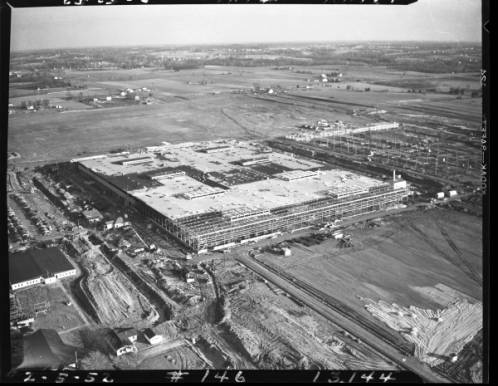
China’s Haier Co. may close on its $5.4 billion purchase of the iconic 65-year-old Appliance Park as soon as Monday. Built during the rapidly growing post-World War II economy, the 1,000-acre park churned out dishwashers and other home appliances for the burgeoning baby boom generation. Construction started in 1951.
With Ford and other big local manufacturers, GE launched a solid middle class that became the foundation of Louisville’s economy. At one time, the park employed 25,000 workers. It was a self-sufficient city providing many of its own needs, right down to mail handling. (In 1953, it got its own Zip Code: 40225.)
But that started to ebb in the 1970s, as manufacturers sought cheaper labor by moving production overseas. Appliance Park now employs only 6,000 workers. Service jobs have become the fastest-growing part of Louisville’s economy. But they’re often part-time and don’t pay as well as factory work once did.
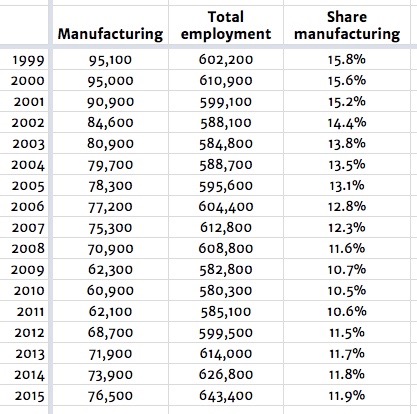
Manufacturing employment last peaked in the Louisville metro area in 1999, when there were an average 95,000 jobs, according to the Bureau of Labor Statistics. It then fell to a low of 60,900 in 2010, when the economy was still recovering from the Great Recession. The better news is that it’s crept up every year since, to 76,500 last year. But it’s extremely unlikely it will ever return to the glory days of 1951, when Appliance Park was king.
Founded in 1993, the company now has nearly 500 restaurants and 48,000 employees.
Boulevard focuses on news about some of Louisville’s biggest employers, nonprofits, and cultural institutions. This is one in an occasional series about them.
Put your books away; it’s time for a pop quiz!
Ever heard of a Louisville-based restaurant chain called KFC? Of course you have. Papa John’s? Certainly.
Now, what about that other big Louisville-based chain: Texas Roadhouse. Not so much?
KFC (15,000 restaurants in more than 125 countries) and Papa John’s (4,700 stores, 37 nations) are better known in Louisville at least partly because they’re older, and promote themselves more locally. There’s the KFC Yum Center downtown, and Papa John’s Cardinal Stadium at the University of Louisville. And who hasn’t seen Papa John’s founder John Schnatter in one of his ubiquitous TV commercials?
Taylor
But Texas Roadhouse has come a long way, too — and in a relatively short time. Chairman and CEO Kent Taylorstarted the steakhouse chain in 1993 with a single restaurant in southern Indiana. Some 23 years later, it’s grown to nearly 500 company-owned and franchised restaurants in 49 states plus five foreign countries, and 48,000 employees.
That three big restaurant companies are all based in Louisville isn’t a huge surprise given an economic principle with an unwieldy name: agglomeration. That’s where companies beget other companies in the same industry nearby, all benefiting from the increasingly specialized labor pool and economies of scale: for example, intellectual property attorneys experienced in the fast-food trade.
Western theme peanut shells.
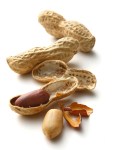
Taylor, for one, started out as a KFC manager in 1990, when he returned to his Louisville hometown. Three years later, he opened the first Texas Roadhouse, in Clarksville, Ind. The restaurants are known for their western themes, line-dancing servers, peanut shell-strewn floors, and Texas Red Chili and ribs.
Now 60, Taylor is the biggest individual stockholder, with 4.4 million shares, or 6.2% of all, according to the 2016 shareholders’ proxy report. His stake was worth more than $200 million in June 2016, when shares were trading at a record high of $46 each.
Boulevard focuses on news about some of Louisville’s biggest employers, nonprofits, and cultural institutions. This is one in an occasional series about them.
Schnatter
Some of the most successful U.S. companies got launched in garages, and Papa John’s story begins there in 1984 — sort of. It involves a car, specifically founder John Schnatter‘s prized gold 1972 Camaro Z28. After graduating from Ball State University with a business degree, Schnatter sold it for $2,800 to help save his father’s tavern, Mick’s Lounge, from bankruptcy.
“He knocked down the broom closet of Mick’s Lounge,” the company says on its history page, “purchased used restaurant equipment, and began delivering pizzas out of the back of the bar.”
The famous car.
Only a year later, Schnatter opened his first Papa John’s in Jeffersonville, Ind. More than 30 years later, it’s now a fast-food giant with 4,700 restaurants worldwide — including more than 1,200 international restaurants in 37 countries and territories. It has 750 employees in Louisville, and another 21,000 across the globe. The company went public in 1993.
The company’s success has made Schnatter — born Nov. 23, 1961, in Jeffersonville — one of Kentucky’s wealthiest residents. His 10.5 million shares were worth well over $600 million in June 2016, enough to buy naming rights to 55,000-seat Papa John’s Cardinal Stadium at the University of Louisville.
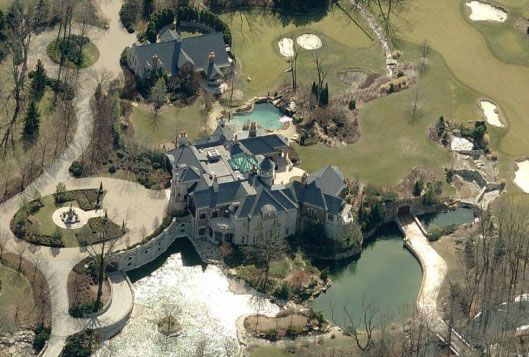
And, of course, there’s his famous Anchorage home: a 40,000-square-foot castle on 16 acres. It features a 22-car underground garage (complete with an office for valet parking, a car wash and even a motorized turn able to move limousines), and a 6,000-square-foot detached carriage house, according to Curbed. The real estate site called it “utterly bonkers,” and posted this aerial photo:
The photo doesn’t appear to show the helicopter landing pad WDRB said spurred neighborhood noise complaints last month.
And the prized Camaro? In 2009, Papa John’s announced a $250,000 reward for the car, leading to its recovery. A replica now sits in the lobby of Papa John’s headquarters at 2002 Papa John’s Blvd.
News about business and culture in Louisville, Ky.




 The new Fortune 500 list of the biggest-revenue companies includes three in Louisville. HUMANA (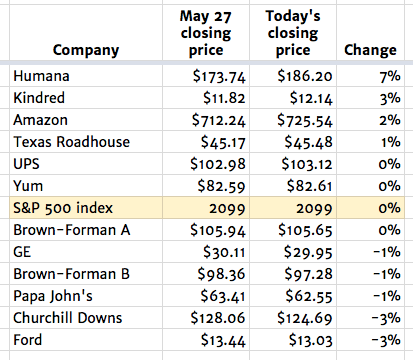




 Boulevard