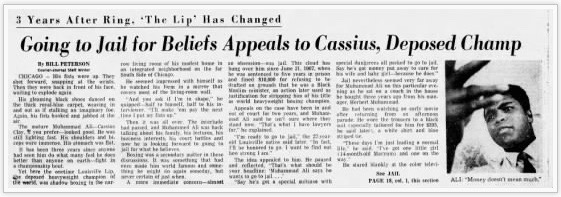
Shortly after he defeated Sonny Liston to win the heavyweight title in February 1964, Cassius Clay changed his name to Muhammad Ali. The new name, bestowed by Nation of Islam leader Elijah Muhammad, “was important to Ali, who referred to Cassius Clay as his slave name and took umbrage when people used it,” The New York Times says in a new story.
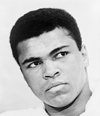
But in The Courier-Journal, the Times, and many other papers and magazines, “Cassius Clay won the Liston rematch in 1965, Cassius Clay beat Cleveland Williams in 1966, and Cassius Clay refused to be inducted into the Army in 1967.”
Indeed, the earliest CJ reference to the late Louisville native by his chosen name didn’t come until Aug 24, 1969, when the paper’s Bill Petersen interviewed him in Chicago, according to a search this morning of the CJ archives in Newspapers.com. At the time, Ali faced five years in prison and a $10,000* fine after his 1967 draft evasion conviction; on appeal, the U.S. Supreme Court eventually threw it out. (Correction: In fact, the CJ used “Ali” as early as 1964, the year he adopted it; please read this new post.)
Under a Page One headline that said, “Going to Jail for Beliefs Appeals to Cassius, Deposed Champ,” Peterson wrote: “The mature Muhammad Ali — Cassius Clay, if you prefer — looked good. He was still [lightning] fast. His shoulders and biceps were immense. His stomach was flat.”
Ali died last week in Phoenix, his primary home, after battling Parkinson’s disease for decades; he was 74. He will be buried at Cave Hill Cemetery today.
* $65,000 in 2016 dollars, according to the Bureau of Labor Statistics inflation calculator.
 “New Ford
  For a glimpse of what the Courier-Journal can do when it really commits resources, consider today’s installment of the quarterly premium sections introduced in March. It’s devoted to all things food: from farmer’s markets to an impressive farm-to-table restaurant guide. It’s handsomely designed, as you can see in the photo, left, of the cover.
 Boulevard